



In October 2022, the U.S. Environmental Protection Agency (EPA) announced $2 million in research grant funding as part of their Lagoon Wastewater Treatment Plan. The grants are one component of the EPA’s Lagoon Wastewater Treatment Action Plan, a broad initiative to assist small, rural, and tribal communities with the utilization of lagoon wastewater systems.
The grants were awarded to West Virginia University and Michigan Technological University to help identify process and technology improvements in wastewater lagoon systems.
Why Lagoons?
Approximately one in four of the Publicly Owned Treatment Systems (POTWs) in the U.S. use lagoon treatment systems to achieve secondary containment treatment levels. The term “lagoon,” when used in regard to wastewater treatment, can be used synonymously with “pond” or “impoundment.” The broader term describes a confined body of water adjacent to an estuary. However, here we are referring to open impoundments used in wastewater treatment as lagoons. Wastewater treatment impoundments can be aerated, anaerobic, or facultative.
We will take a deeper look at facultative lagoons in this blog.
Source: EPA
Facultative Lagoons
Facultative lagoons have been used for decades because of their low operational complexities and costs. They also offer minimal ability for operational control and instead rely on natural processes. As effluent standards have become more restrictive, many communities have been forced to adopt more controllable mechanical treatment processes.
Still, facultative lagoons are a good alternative when the community does not have the resources for other treatment methods. The EPA is attempting to provide direction to improve the lagoon process for more reliable treatment and nutrient (ammonia, phosphorus) removal. This might include additional post lagoon treatment processes.
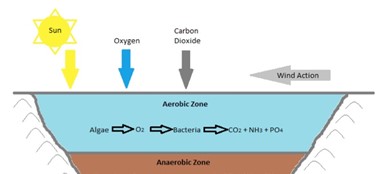
Chemical reactions within a facultative lagoon
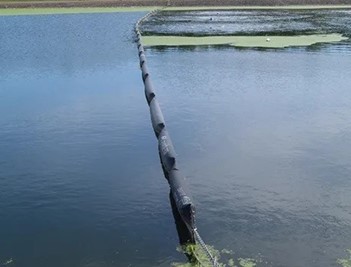
XR-5® Geomembrane Diversion Baffle in a Facultative Lagoon
Source: Environetics
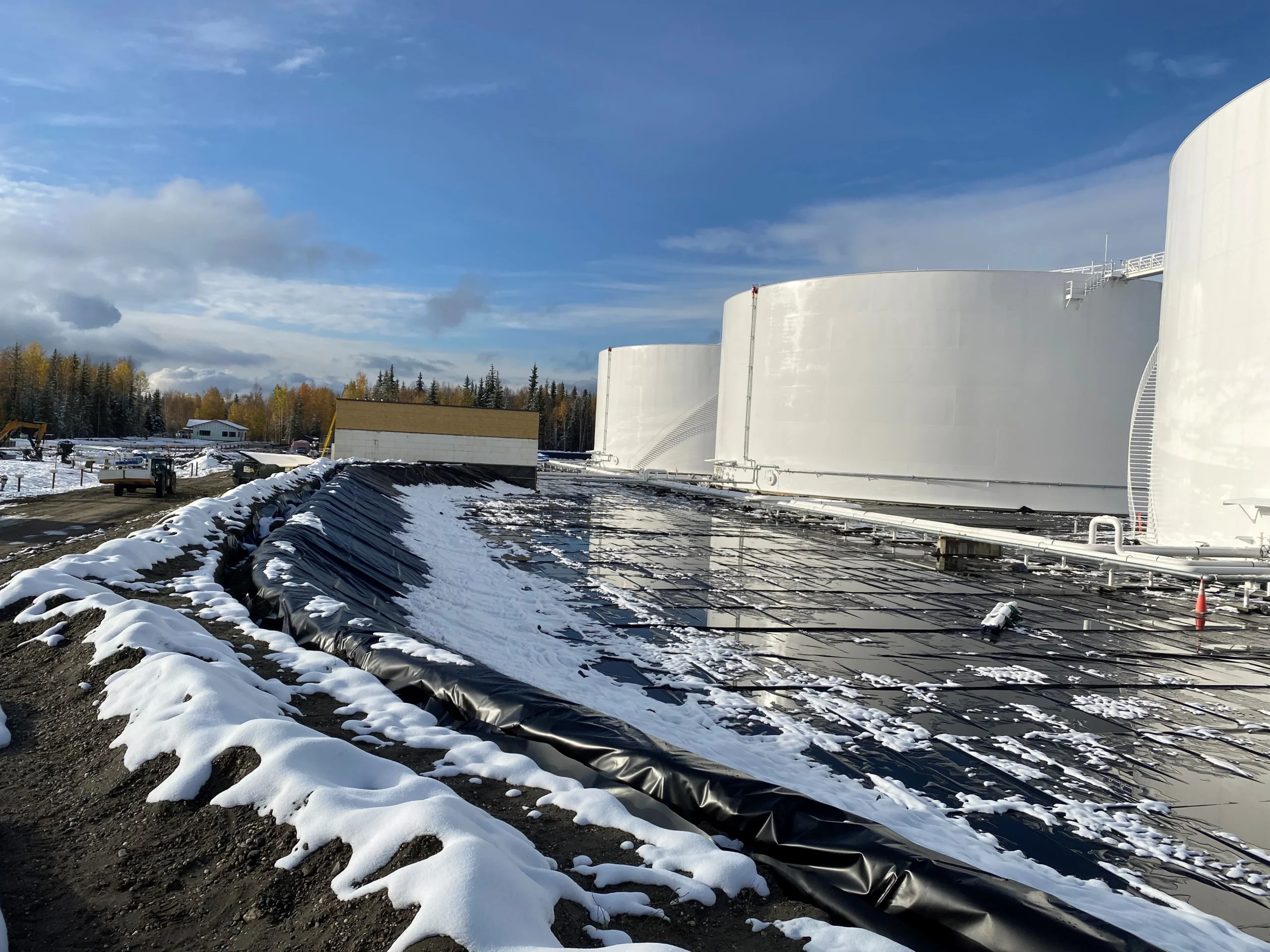
Geomembranes for Lagoon Lining
Geomembrane containment is a common feature in all types of wastewater lagoons. In the past, clay barriers—either natural or constructed—were the most common materials used because of the perceived cost, and uncertainty at the time with the reliability, of geomembranes.
Now, properly designed geomembrane systems are recognized as cost-effective and providing superior hydraulic containment. Impoundment—or conveyance channel—lining was the first geomembrane application.
Wastewater lagoons are most often used for municipal sewage and thus have the potential to leach undesirable components into water supplies, both ground and surface. Currently, limited standards exist for lagoon geomembranes. Of those that do exist, other than basic compatibility and strength properties, they are often arbitrarily based simply on thickness. However, some references caution the designer that stress cracking is a concern with exposed polyethylene geomembranes.
While small, rural, and tribal communities require low operational maintenance for their wastewater systems, geomembranes remain an essential feature to protect water supplies. Such requirements demand geomembrane systems with the following characteristics:
- The ability to remain uncovered so slope maintenance is not required.
- Excellent UV resistance.
- Negligible thermal expansion-contraction rates so geomembrane repairs are minimal over the life of the material.
- High puncture resistance and yield tensile. Seam strength greater than or equal to geomembrane sheet strength.
- Broad range of chemical resistance to withstand the highly variable nature of municipal wastewaters.
- Prefabrication capability to minimize field seams and, subsequently, potential for leakage.
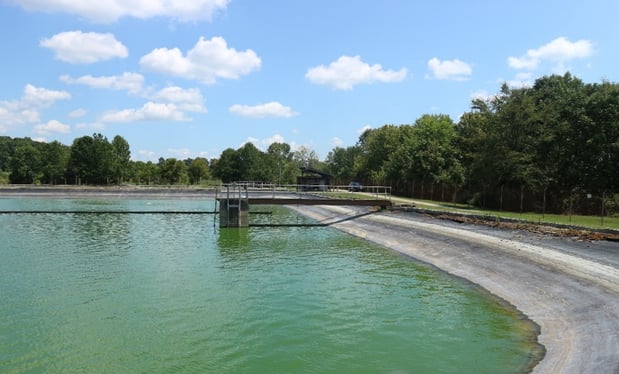
XR-5® Geomembrane lined lagoon. Installed 1984 – Photo Date 2019 Kentucky USA
Source: Seaman Corporation
As stated previously, lagoons, particularly facultative lagoons, can be a good choice for wastewater treatment when minimal financial, operational, and/or maintenance resources are available. These same communities cannot afford to be the cause of water pollution, so the right geomembrane lining system must be selected to provide protection, with low maintenance. Federal revolving and other grant-based financing is often available for construction of facilities, but not for operation, maintenance, and/or cleanup.
Select the right geomembrane for your lagoon-based wastewater treatment system.
To review the EPA Lagoon Wastewater Treatment Action Plan, click here.