



Building-integrated photovoltaic systems are becoming increasingly popular as either the main or supplementary source of power in all types of building projects. Integrating flexible photovoltaic solar panels with fiber roofing systems is a fairly new innovation, led by companies like Pvilion, a designer and manufacturer of flexible photovoltaic solar structures and products.
Solar Integrated Membrane Structure
Advanced Technology
As technology has improved, flexible photovoltaic panels can now be part of fully integrated photovoltaic membrane structures. These systems have undergone decades of research, development and testing to ensure viability and demonstrate lasting functionality. Solar Integrated Membrane Structure.
Having demonstrated compliance with the International Electrical Code (IEC) and United Labs (UL), the three projects shown have all been approved by the local building departments.
Photovoltaic Membrane Systems Continue Evolving
Very few companies specialize in this technology as it takes a significant effort in research, development and testing to demonstrate compatibility and efficacy of the solar fabric integration under environmental and structural conditions . Pvilion began working with Shelter-Rite in 2014. Pvilion required a durable and strong fabric that was suitable for a variety of applications and technical needs.
As solar fabric membranes continue to advance, it has led to numerous innovations such as the world’s first tensile structure house that meets the “Passivhaus” energy standard, the most stringent energy standard in the world. This project was designed by students at Rhode Island School of Design, Brown University, and Erfurt University as part of an international Solar Decathlon competition.
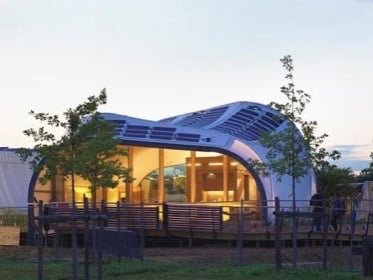 Techstyle Haus, a Solar Decathlon project house featuring a photovoltaic fabric roof, designed and manufactured by Pvilion with Shelter-Rite fabric. Completed June, 2014.
This project achieved a number of “firsts,” such as proprietary techniques and processes to allow Pvilion solar membranes to be installed as a second skin over a primary roof membrane. This technology could fit or retro-fit photovoltaic skins onto new or pre-existing membrane roofs, allowing the second photovoltaic skin to be installed and maintained separately from the main skin.
Another project, a solar parking structure at Google’s Mountain View campus, covers electric vehicle parking spaces and helps charge the cars below. Such structures have many advantages, including simple installation thanks to factory prefabrication, and ease of relocation.

“Solar Sail” photovoltaic parking structure at Google’s Mountain View campus, Design/Build by Pvilion with Shelter-Rite fabric. Completed in March, 2015.
This technology translates well to larger jobs, such as the canopy over the Capital Cascades Connector Bridge in Tallahassee, Florida. The canopy adds a key design element, and the integrated solar array generates enough power to offset the power used for the bridge lighting.
 1-1.jpg) Capital Cascades Connector Bridge canopy, Design/build by Pvilion, with Shelter-Rite fabric. Completed in October, 2016. (Photography credit: Adam Cohen)
Capital Cascades Connector Bridge canopy, Design/build by Pvilion, with Shelter-Rite fabric. Completed in October, 2016. (Photography credit: Adam Cohen)
 -1.jpg)
Capital Cascades Connector Bridge canopy, with LED Lighting (Photography credit: Adam Cohen)
Proven Performance
Advanced photovoltaic membranes have been working well in a variety of environments and applications for several years. The Capital Cascades Connector Bridge canopy has withstood one hurricane and one tropical storm in two seasons with no sign of degradation. The Techstyle Haus has been in use since the summer of 2014, having been installed, disassembled, and relocated three times.
As flexible solar modules continue to improve, this technology will become even more efficient and cost-effective. It is an outstanding option wherever membrane structures are used, such as athletic facilities, architectural features, parking structures and much more.
Robert Lerner from Pvilion Technologies contributed to this blog post.