



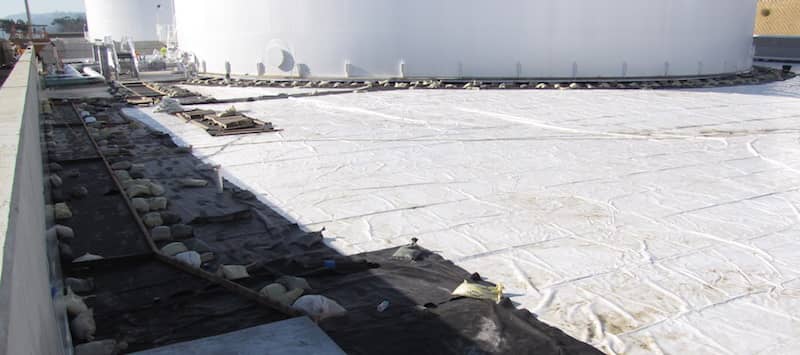
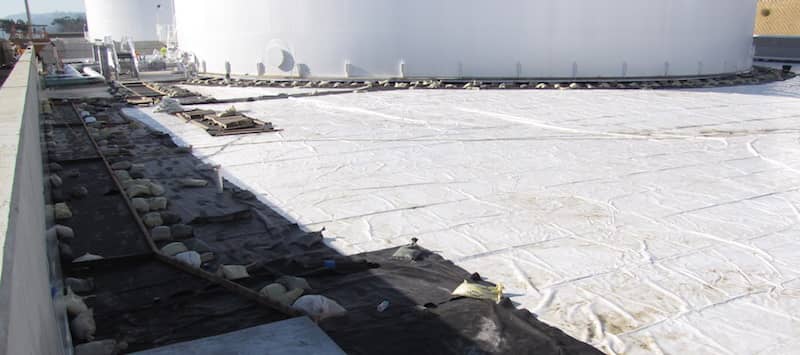
 Geomembranes can fail for a variety of reasons. A failure in a geomembrane can result in serious damage to the surrounding environment and ecosystem. In order to help keep your geomembrane performing at its best, here are three common geomembrane failure mechanisms to keep in mind.
Punctures
When a geomembrane reaches a construction site, it has the potential to be punctured by a variety of sources, such as birds, plants, or animals that peck, protrude, and scratch geomembrane liners. Although wildlife-caused punctures are not as common as the other types, it is still a problem. Typically, the damage from animals and plants takes a few years to culminate, but once it does, leaks and cracking can occur within your geomembrane liner.
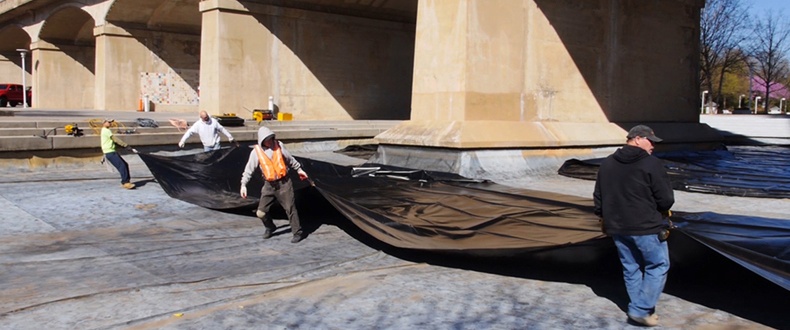
When installing a geomembrane liner, it is important to be mindful with your construction equipment. When machinery, or 100-pound sand tubes, are moving across the top of the liner, they can pull at the protective top coat and thus removing it.
Angular rocks are also a common cause of geomembrane punctures. Whether the geomembrane liner needs angular rocks for slowing down water currents or for cooling down chemicals or other liquids, it is a best practice to install a geotextile between the rocks and your geomembrane. This will offer some puncture protection. Be sure to contact the geomembrane manufacturer for recommendations regarding the kind of geotextile you should be using, or whether a geotextile is needed for that project in the first place.
Environmental Stress Cracking (ESC)
ASTM D883 defines ESC as “an external or internal crack in a plastic caused by tensile stresses less than its short-term mechanical strength.” ESC is most commonly, if not exclusively, seen with high-density polyethylene (HDPE) geomembranes, while EIA geomembranes (like XR-5® Geomembranes) are engineered with low thermal expansion properties, making them more dimensionally stable.
When ESC occurs, the crack will cause a chain reaction, propagating through the liner and seriously compromising the liner’s integrity. ESC can occur anytime during the lifespan of your geomembrane, meaning that you might have to replace it entirely before seeing a return on your investment.
While the individual factors that cause ESC are known, the exact combination of these factors is still a mystery, making ESC prediction difficult. Some factors include:
- Molecular bonding
- Crystalline
- Polymer type
- Environment
- Geomembrane application
- UV radiation
To help reduce the likelihood of ESC and HDPE failure, it is best to keep uniform, unreinforced geomembranes, like HDPE, buried and not exposed to the sun’s UV rays. HDPE failures have come to public attention far short of long-term performance.
Wicking
If you install a geomembrane that has a high propensity to wick, you could be setting yourself up for premature failure. Wicking occurs when the coating separates from the base fabric or yarns in the reinforced geomembrane. This can also happen in unreinforced geomembranes when the layer of the uniform material starts to peel away from itself. This phenomenon can jeopardize the overall integrity of the geomembrane.
Be sure to double-check with your geomembrane manufacturer to avoid specifying a geomembrane that might be more likely to experience wicking for your application, if it happens at all. Some geomembranes are prone to wicking, while others are anti-wick. If wicking does prove to be an issue, contact your manufacturer for guidance.
Always talk with a variety of geomembrane manufacturers before specifying or purchasing material. They will help you find the right geomembrane material for your application.