



 When considering options for primary and secondary containment in the storage of water, fuels, and industrial liquids, the design engineer may consider several options. Concrete, a common choice, provides several advantages. It is resistant to the elemental forces of nature including UV, precipitation, and variations in temperature. Concrete can provide a stable working platform resistant to traffic forces from heavy equipment used in operations and maintenance. Concrete also offers the advantage of being durable. In a study completed by Swihart and Haynes1 for the Bureau of Reclamation, it was concluded that concrete containment systems could last as long as 40 – 60 years (page 203, Table 18, Canal Lining Demonstration Project, November 2002). With that being said, reinforced flexible membrane liners (rFMLs) are a better choice, as depicted by the following reasons.
1. Concrete Leaks
Concrete falls short in its most important function as a containment system: it leaks. In the same study by Swihart and Haynes, it was found that concrete is only 70% effective as a containment medium. In a similar study completed by Korulla and Khan2 (Geomembrane in Canals, Project Monitor, Minimol Korulla & Shabana Khan, May 2011) it was found that concrete containments can experience leakage rates as high as 30%. The leakage is primarily a function of cracking and inadequately treated expansion joints. Many agencies require that not just concrete joints but entire concrete surfaces be sealed. The federal guideline, UFC 3-460-01, for example in secondary containment for fuel storage, requires that entire concrete storage areas be sealed with UV-resistant, Fuel-resistant coatings (UFC 3-460-01, 8/2010, pg 146). Even with the sealant provision, the UFC 3-460-01 guideline requires a geomembrane to be used in conjunction with concrete in secondary containment applications. Concrete is also subject to soil considerations in containment designs. A properly chosen and installed rFML will last 20 to 30 years without cracking or leaking.
2. Concrete is Expensive
Prices for typical 4 inch reinforced concrete sections range from $6.00 to $7.00 per square foot installed (typical USACE cost). rFMLs will cost anywhere from $.50/sf once installed for lower end polypropylene and polyethylene geomembranes and up to $2.50/sf installed for high-performance alloyed PVC EIA liners.
3. Concrete Can Require Costly Subgrade Consideration and Amendment
Expansive and chemically aggressive soils must be taken into account in concrete containment designs and care must be taken to assure that subgrade conditions are acceptable. Remediating poor soils prior to construction of concrete can add to overall project costs. The presence of sulfates in subgrades must also be considered when using concrete. This is especially true of applications involving waste or seawater. Since the polymers used in rFMLs are chemically inert, there is no additional design or expense required when using liners over soils with high sulfate content.
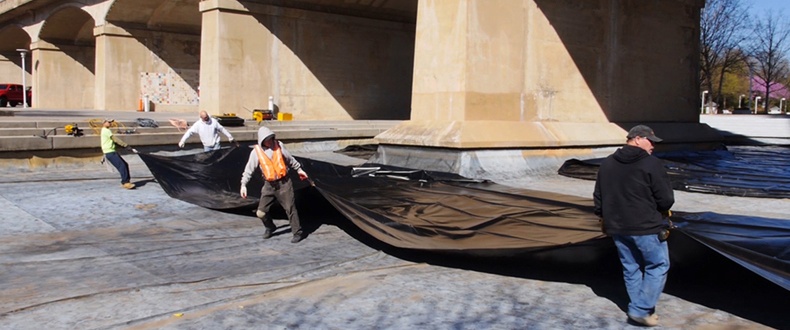
Due to the fact concrete is a rigid medium, expansive and soft subgrades must also be considered when designing concrete containments. The use of rFMLs minimizes the need to consider subgrade conditions in containment designs. Because they are flexible, they are able to accommodate expansion in clayey soils. Soft subgrades are also less of a concern with rFMLs because liners are able to accommodate soil deformations by flexing or elongating.
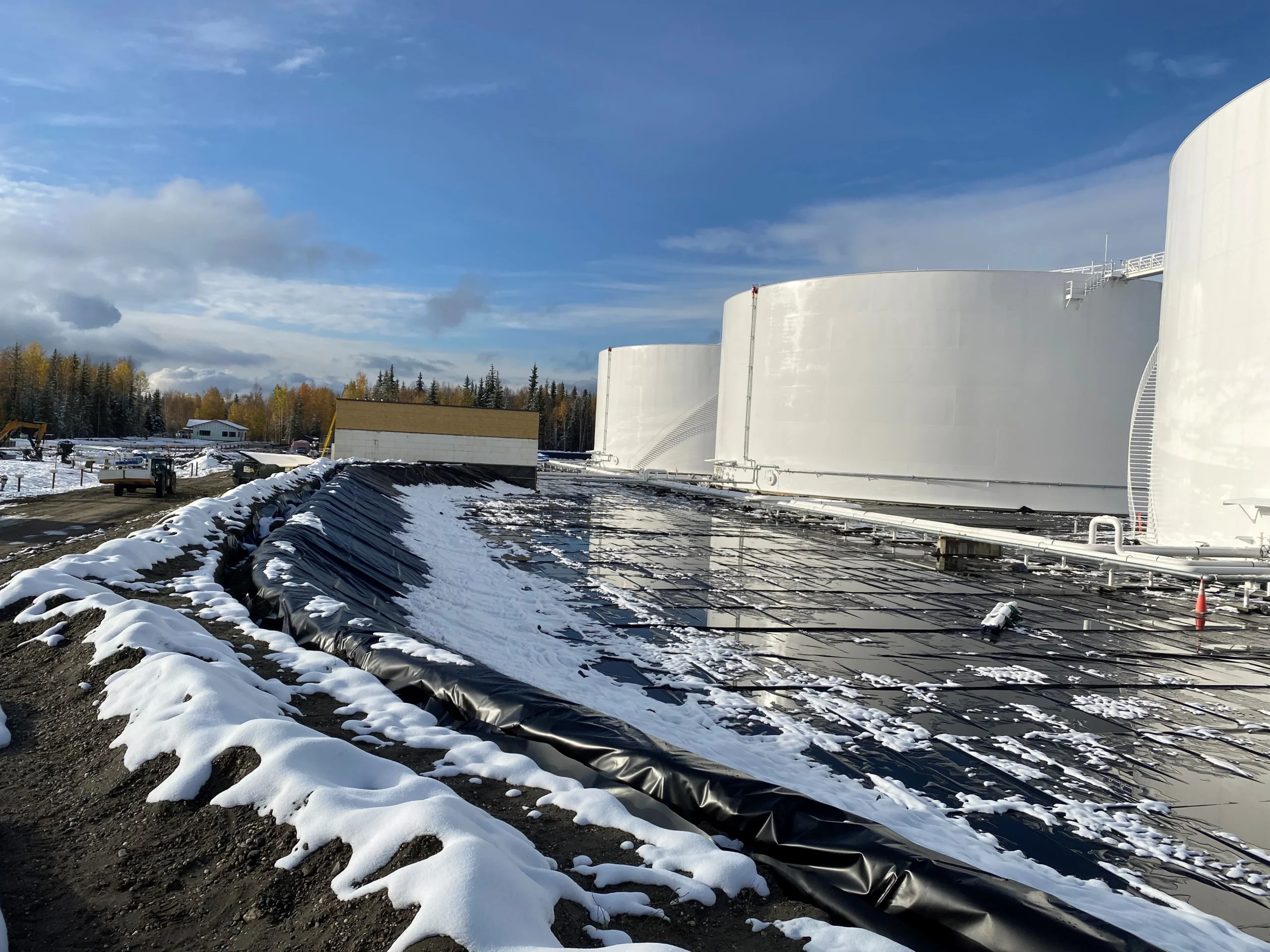
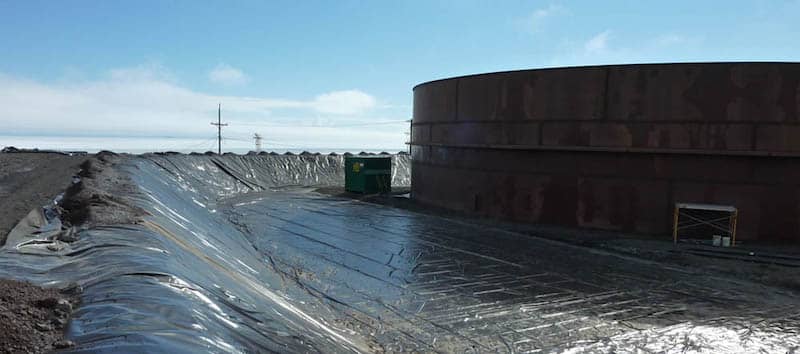
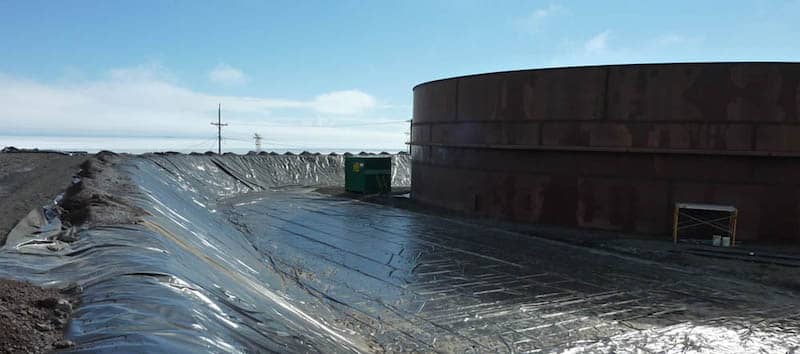
Ultimately, reinforced flexible membrane liners offer superior performance over concrete for containment applications. rFMLs are less expensive than concrete. The flexibility inherent in rFMLs means they are more easily and quickly transported and deployed than concrete treatments. rFMLs require less subgrade treatment and can be more frequently deployed on existing subgrades with minimal preparation as a result. rFMLs are inert and inherently more resistant to a broad range of chemicals. They are also environmentally stable, allowing them to be used in wide range of temperatures while exposed to extreme UV. rFMLs should be the design engineer’s first choice for primary or secondary containment.