



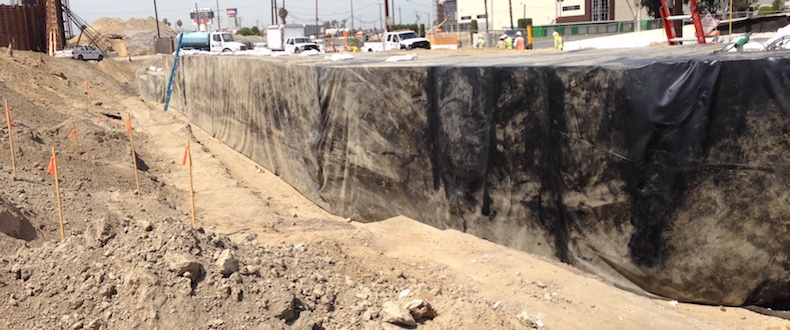
In a previous blog post, I discussed the benefits of using EPS geofoam for highway construction. Geofoam has many benefits in the transportation market and has found itself in many well-placed areas. In this blog I’ll review what geofoam is and how to install it.
What Is Geofoam?
Geofoam is rigid lightweight plastic foam also known as EPS geofoam (expanded polystyrene). Geofoam products are made of the same material as styrofoam cups and insulation foam, yet the foam didn’t branch off into its own market until the early 1970s. It was first used in the Oslo, Norway, Flom Bridge project in 1972. As a crucial part of the embankments around the bridge, the foam helped reduce settlement.
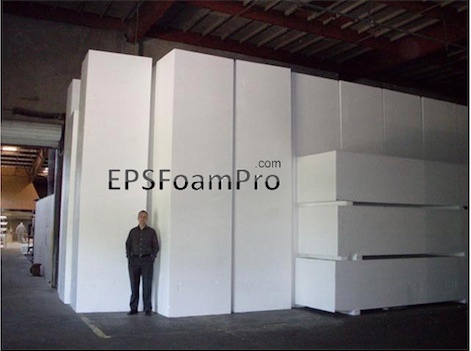 Picture 2: epsfoampro.com
Due to the success of the Flom Bridge, the first ever International Geofoam Conference was held in Oslo, Norway, in 1985 for engineers to exchange knowledge and case histories. Post conference, geofoam started taking over the civil engineering market almost overnight. Japanese engineers took note of this new construction material, and between 1985 and 1987, over a million cubic meters of geofoam was used in 2,000 projects to make up for Japan’s soft soil.
Geofoam made it to the States on a few projects in the late 1980s, but did not pick up traction until 1997 when Interstate 15 in Salt Lake City, Utah, needed to be reconstructed to accommodate traffic for the 2002 Winter Olympics. The Utah Department of Transportation (UDOT), in conjunction with Wasatch Constructors, completed the project in 2001, seven months before the Winter Olympics. If the project had been constructed using conventional methods, the construction process would have been extended months past the actual completion date.
How to Use Geofoam as Part of a Road Installation
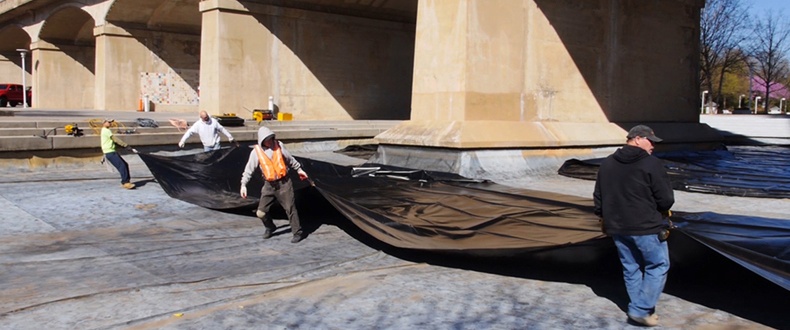
Once the location of a new road is chosen, the sight must be excavated (if needed) to level the ground. In some cases, sand is evenly distributed to help level areas where the geofoam block will be installed. A gasoline-resistant geomembrane (approved by the local DOT) is placed on top of the sand to eventually wrap around the geofoam blocks.
If the local DOT doesn’t have a recommended geomembrane, a good rule of thumb is to find a geomembrane that is strong, flexible, has the toughness of at least 14,000 or 11,000, and with a maximum vapor transmission rate of a least 0.4 oz/24hr/ft2. The toughness property is a spec used in DOT geomembrane/geofoam projects and is the product of the percent elongation and the grab tensile strength of the geomembrane (both official ASTM D751 tests). The 14,000 toughness tends to be 22% elongation by ~650lbf grab tensile; while the 11,000 toughness tends to be 20% elongation by 550lbf grab tensile. Please contact us for recommendations or example DOT specs.
These rules of thumb are very important because the stronger and more flexible a geomembrane tends to be, the easier the installation process can be for the construction workers. The stronger geomembranes won’t accidentally be punctured by rocks, debris, or other construction equipment during installation or in its lifespan due to roots and animals. The more flexible geomembranes will be more pliable and can be wrapped around geofoam more easily. Believe me, the construction workers will thank you.
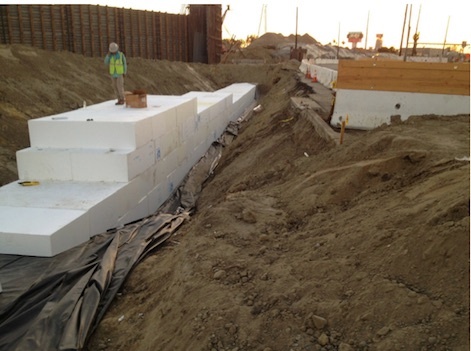
Geofoam blocks are then placed on top of the geomembrane and positioned in such a way that no voids are created between the foam. If unique block sizes are needed, the foam can be cut using a heated wire. In some cases, when two or more layers of geofoam blocks are stacked on top of one another, timber clips are placed in between the blocks to prevent slippage (basically, it’s like playing with giant Legos).
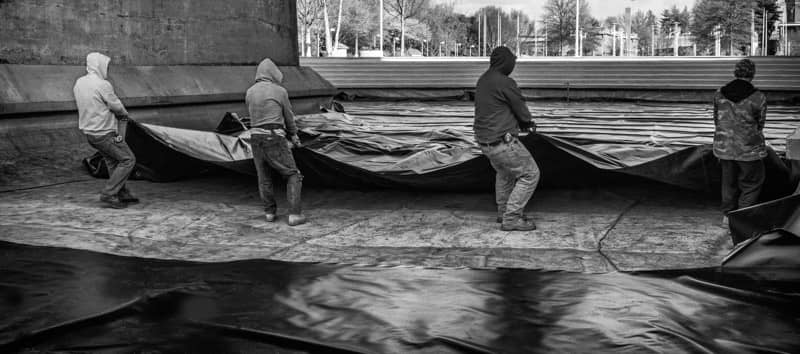
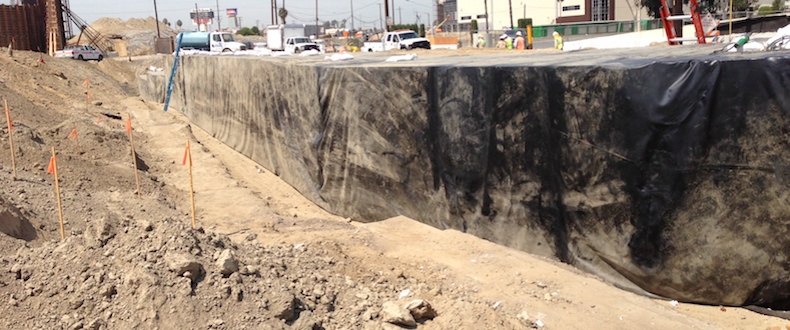
Once all the blocks are placed, the geomembrane is then wrapped around the geofoam and welded with a wedge or heat welder. Chemical and extrusion welding of the membrane isn’t recommended because it will negatively impact the geofoam. The geomembrane protects the foam from any type of hydrocarbon chemicals, such as petroleum.
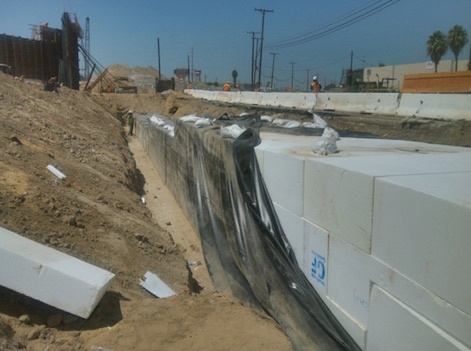 Picture 4: Seaman Corp – California Interstate 5 off-ramp
Steel-reinforced mesh is then placed on top of the membrane and 4 inches of concrete is poured over the top to help distribute the potential load. Throughout the block placement, soil is poured and compacted around the geofoam structure. Once the concrete has set, the project is completed with the formation of the road-bed and pavement.
Reasons to use geofoam:
- Project location has weak soil
- Short or shorter project time frame is needed/wanted
- Money saver
- Soil frost protection
- Can contribute to LEED credit requirements
Applications:
- New highway and road construction
- Temporary road construction
- Bridge abutments
- Landslide areas with weak soil
- Artificial landscape
- Retaining walls
- Railway track systems
- Airfield pavements