



Skip to content
logo
Commercial & Public Spaces Data Centers Food & Beverage Government & Emergency Response Manufacturing Power, Oil, & Gas Sports & Leisure Transportation & Infrastructure Water & Wastewater Management
feature image

Commercial Roofing

logo-fibertite
Geomembranes

Geomembranes

logo-xr
Architectural Fabrics

Architectural Fabrics

logo-architectural
Innovative Fabric Solutions

Industrial Fabrics

logo

About Seaman Corporation

Seaman Corporation is a privately held, multi-generational family-owned U.S. manufacturer and trusted provider of protective solutions, delivering high-performance industrial coated fabrics since 1949.

Read More
Corporate Responsibility Our Impact Our History Leadership and Governance Careers

Our Insights

Explore Our Insights
Case Studies Competitive Comparisons Blogs Press Room Webinars

Contact Seaman
Corporation

800-927-8578 Send A Message Now

Locations

World Headquarters

Seaman Corporation
1000 Venture Boulevard
Wooster, Ohio 44691

330-262-1111 330-263-6950

Bristol, Tennessee

Seaman Corporation
PO Box 3946
225 N. Industrial Drive
Bristol, TN 37620

423-989-5200 423-989-5215

More ways to Connect

Careers
Credit Application
Blogs

Evaporation Pond Operation and Containment Requirements

A brief overview regarding the theory of evaporation ponds, the industries where the process is in use, and the function, selection, and design of geomembrane systems for use in evaporation ponds.

Geomembrane Selection and Use in Evaporation Ponds

Part 1:  Evaporation Pond Operation and Containment Requirements

“the air of the open country is asstonishingly dry as well as pure. I found by several experiments that a table spoon full of water exposed to the air in a saucer would avaporate in 36 hours when the murcury did not stand higher than the temperate point at the greatest heat of the day; my inkstand so frequently becoming dry put me on this experiment. I also observed the well seasoned case of my sextant shrunk considerably and the joints opened.”

Meriwether Lewis, May 30, 1805, Chouteau County, Montana

Captain Lewis was not known for his grammar and spelling, but as an Easterner, he was amazed at the evaporation rates in the arid western US. Today, all over the world, geomembranes are used to line evaporation ponds, providing an economical and easily operated process for removing or separating water. This post will look at the theory of evaporation ponds, the industries where the process is in use, and the function, selection, and design of geomembrane systems for use in evaporation ponds.

The area where the 1805 post was created receives about 15 inches of rainfall per year, while the average evaporation is about 45” (Great Falls and Fort Peck Dam, respectively). There are multiple methods of quantifying evaporation rates, but this amount seems to be the standard for that area. Phoenix, for comparison, has an annual rainfall of about 8” and evaporation of about 74”. Water balance differentials of this type are essential for an engineered evaporation process, coupled with low humidity and open land.

Typically, on a yearly basis east of the Mississippi River rainfall will exceed evaporation. When I was consulting, we did some preliminary site work at an industrial facility in Eastern Tennessee. They generated acidic wastewater that was batch dumped into two small unlined impoundments. There was no discharge from the impoundments and the facility boasted that there was no discharge because of evaporation. A quick check of the pH in the creek downgradient initiated a long remediation process.
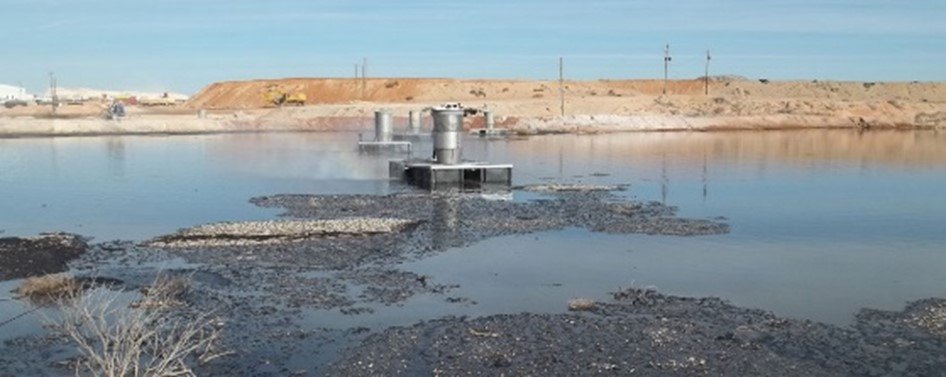
evap pondEvaporation pond. Source:  RWI Enhanced Evaporation

What are the applications for evaporation ponds? Three of the major applications are as follows.

1.    Desalination for the product of salt. Simply placing seawater in lined impoundments allows the water to evaporate, leaving behind only the salt.
2.    Oil & Gas. Many operations produce oily and/or high dissolved solids water. Evaporation ponds hold these liquids to minimize the volume of the oily water or separate the water from the solids. Pretreatment is needed to remove oil for reduction in surface area for evaporation.
3.    Mining. Some mining operations use large volumes of water and are in climatic areas more favorable to evaporation processes.

While these major categories are the most frequent users of evaporation processes, there are others, including industrial and even municipal wastewater applications. Both are process and site-specific. The increased emphasis on water reuse and greywater use has raised awareness for water as an asset rather than a resource for disposal (or evaporated). Still, evaporation is valued as a wastewater management tool in certain situations.

The 2nd part of this series will cover the processes which occur in evaporation ponds and the corresponding geomembrane properties needed.

View Part 2 and Part 3 of this series.

Subscribe for more Insights from XR® Geomembranes

Insights Journals

receiving award
Blogs

Seaman Corporation Earns WEDC Quality Growth Award

The Wayne Economic Development Council recently honored Seaman Corporation with the Quality Growth Award and its Chairman, Richard Seaman, with the Chris Schmid Community Impact Award at its Annual Meeting.

Blogs

How Does a Geomembrane Hold Up 18 Months After It Is Installed?

It is difficult to estimate the life of a geomembrane, but there are ways to prolong it. Learn how these factors impact the weathering of your geomembrane.

Blogs

5 Things I Learned Watching a Geomembrane Installation

It is difficult to estimate the life of a geomembrane, but there are ways to prolong it. Learn how these factors impact the weathering of your geomembrane.

Blogs

Why Local Governments Should Consider Fabric Structures

Portable tension structures have numerous benefits such as additional emergency shelter. Learn why you should use portable tension structures here.

Explore Insights
logo
Privacy Policy Legal

Made in the U.S.A.

Family-owned U.S. manufacturer since 1949

Copyright © 2026 Seaman Corporation. All Rights Reserved.