



In the Zone: Fire Protection Starts with Defending the First Five Feet
In 2024, wildfires consumed more than 8.9 million acres across the United States, which was triple the damage seen in 2023. According to the National Interagency Fire Center, more than 64,000 wildfires were recorded this past year, far outpacing the ten-year average. While regions traditionally known for wildfires continue to be at high risk, these numbers reflect a sobering truth: fire danger is spreading, and no facility can afford to ignore it.
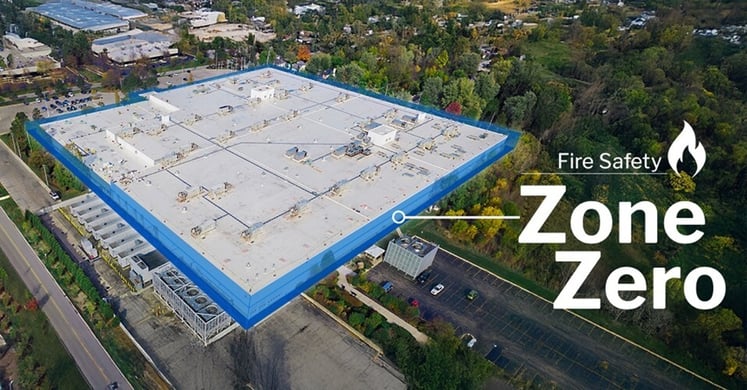
For managers of commercial spaces, industrial buildings or critical facilities, maintaining a secure immediate perimeter can significantly reduce the risk posed by unexpected nearby fires and drifting embers. Your roof system is part of that immediate perimeter, which fire experts call Zone Zero.
What Is Zone Zero? Why Is It So Important?
Zone Zero is the five-foot area immediately surrounding a building’s exterior. Sometimes called the “defensible space zone” or “home ignition zone,” this critical area is often overlooked when it comes to protecting structures from fire. And this oversight is somewhat excusable. Managers focus on fires that start within their building, not from somewhere else. Yet fire behavior studies consistently show this zone is where embers pose the most potential danger when they ignite nearby materials and elements.
The importance of Zone Zero shows how fire doesn’t need to be next door to be a threat. A fire may start miles away, but embers carried by wind find their way into leaf piles, under decks or even onto rooftops. There are no smoke alarms or sprinkler systems in Zone Zero, so a small flame there can become a full-blown structural fire within minutes.
The Role of the Roof in Fire Risk
When people think of Zone Zero, they intuitively assume fire risk at the ground level. The leaves and debris in surrounding flower beds are what we see first. Yet the rooftops—often away from our field of vision—are part of Zone Zero and can be just as vulnerable, as we’ve noted before. Rooftop fires are uniquely dangerous for several reasons:
- No detection systems: Most commercial rooftops typically don’t have smoke detectors or alarms.
- No sprinklers: Unlike interior spaces, the roof has no built-in fire suppression systems.
- Hidden threats: Rooftops house HVAC units, solar panels and electrical systems, all of which can malfunction and cause fire, as well as complicate or impede extinguishing efforts.
- Access issues: Rooftop fires are harder to reach and fight, often requiring a specialized response.
- Wind exposure: Elevated and open roofs are prime territory for fire to spread rapidly.
Ground Level: Zone Zero Best Practices
Zone Zero on the ground is your facility’s immediate buffer zone, and is one of the simplest and most effective places to take action.
Removing anything flammable from within five feet of your building perimeter helps mitigate risks from burning embers that could land from a nearby fire. Replace mulch and flammable plants with gravel, rocks or noncombustible hardscaping. Clear leaves, needles and branches from within this zone and repair loose or broken screens and windows to prevent embers from entering the facility.
Upper Level: Choose a Roof That Fights Fire
Even with a pristine Zone Zero at ground level, you’re still at risk if your roof can’t defend itself. The most widely used roof membrane in the United States is TPO, which has a similar composition to motor oil and has been proven to contribute significantly to roof fire spread when used in a typical Class A-rated roof assembly. This only increases the risks and consequences related to a rooftop fire.
FiberTite® roof membranes are engineered differently. They inherently have self-extinguishing properties, meaning once a flame source is removed, the fire has no opportunity to continue burning or spreading across the membrane. This property has been proven to limit or prevent fire from spreading across the roof system according to ASTM E108 Class A testing. If ignited by an ember or other rooftop source, then the risks of significant damage are minimized. The flame resistance and self-extinguishing properties of FiberTite help buy valuable time, contain damage and protect what matters inside the facility.
A Closer Look at the Upper Zone Zero: Common Rooftop Fire Hazards
Today’s commercial roofs are platforms for equipment, access points and mechanical systems. That makes them complex and often combustible. Fire risks include:
- Exhaust vents: Emissions such as oils and fats can build up and become fuel.
- Electrical systems: Faulty wiring or overloaded circuits could result in arcs.
- Storm debris: Branches, leaves and other debris also serve as fuel.
- Poor maintenance: Loose membranes or unchecked damage.
- Human error: Torch use or welding.
Routine inspections and debris removal go a long way, but your roof’s membrane is crucial to make your roof a harder target for fire. In addition to these risks, consider upgrading your membrane with one that has proven fire resistance and self-extinguishing properties, like FiberTite, for maximum risk mitigation.
Class A flame resistance can provide a false sense of security when it comes to risks and consequences of roof fire, and it’s important for building owners and operators to know that risk of fire isn’t hypothetical. It’s real, and it’s growing. By combining smart material choices with regular maintenance and defensible landscaping, you dramatically reduce your building’s risk profile.
The risk of fire will never be zero. But with thoughtful attention to Zone Zero and a roof system that doesn’t fuel the flames, you create a powerful combination of prevention and protection.
Is your facility fire-ready? Download our fire readiness toolkit to get a clearer picture of your risk to external fire threats and discover what you can do to improve: Fire Readiness Toolkit