



“UV Resistance” is a term that applies to the effects of ultraviolet light and is often implied when claiming resistance to the effects of UV-induced thermal resistance. In fact, there are three areas that are influenced by ultraviolet light and/or heat induced from sunlight that often seem to be described in that manner.Let’s look at those, their implications, and how to consider them in designing geomembrane lining systems.
1. Ultraviolet Resistance –
- Ultraviolet resistance is the ability of a material, often a polymer, to withstand the degradation that can be caused by exposure to ultraviolet light (Corrisionpedia). Degradation includes color change, development of brittleness and cracking.
- Most geomembranes are considered resistance to short term degradation due to exposure to natural sunlight. Since the 1950’s, formulations and additives have been tweaked to make these plastics useable in the sunlight when the application demands.
- UV additives, such as UV blockers, absorbers and light stabilizers or a combination thereof are added to polymers to enhance UV light resistance. Carbon black is a common absorber.
- There are several laboratory tests to measure UV resistance:
- ASTM G155 (Solar Radiation)
- ASTM G154 (Humidity including)
- An excellent reference for more information on this testing and other weathering issues can be found here.
SOLUTION: Use geomembranes with polymers formulated to resist long-term UV exposure.
2. Dimensional Stability –
- A measure of permanent deformation as a result of heat. ASTM D1204 is the laboratory test that measures dimensional stability, an index test that shows the degree of internal strains introduced during processing. These stresses remain in the geomembrane when installed.
- Heat, not ultraviolet light, from any source including from sunlight, induces the permanent effects that could be equated to shrinkage.
SOLUTION: Use an Internally reinforced geomembrane with a chemical bond between the reinforcing and the polymer to overcome many of the concerns from dimensional stability in actual field applications. A heavily reinforced product, such as the XR-5 Ethylene Copolymer, exhibits dimensional stability as low as 0.5%, whereas some in the industry approach 5%.
3. Thermal Expansion-Contraction –
- A measure of cyclic non-permanent deformation in the form of changes in linear dimensions as a function of temperature change.
- Polyethylene has some of the highest Coefficient of Thermal Expansion-Contraction (CTE). This is a common phenomenon with PE pipe and other similar products. For geomembranes, ASTM D696 measures CTE.
- Unlike UV Resistance, CTE is an inherit property of the polymer that cannot be substantially modified with additives. Instead, the polymer itself must be modified if the CTE presents design and operational challenges in a geomembrane system. Non crystalline geomembranes have very low CTE.
- For PE’s (generally speaking), CTE can be lowered by using a lower density material. Unfortunately, however, many properties, including chemical resistance, are also reduced with lower densities.
SOLUTION: Completely cover the geomembrane or use alternate polymers with negligible CTE, such as the Ethylene Copolymer XR-5, and some polypropylene products.
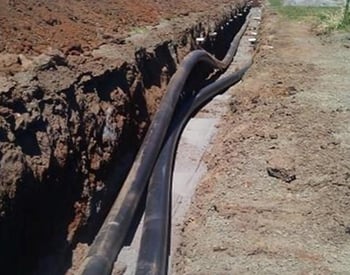 PE pipe expanded in the sunlight
Source: Geooptimize.ca
In closing, consider the actual UV impact, along with the thermal impact, of sunlight on your geomembrane system. Use materials specifically designed for a fully exposed application, or design protective features to accommodate the material properties.
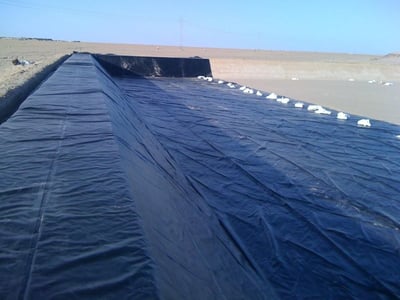 XR-5 Geomembrane exposed in the Libyan desert.
Source: Seaman Corporation