



One way to classify secondary containment of stored industrial liquids is either permanent or portable. Both routinely use the same type of geomembrane as the primary containment layer. In this blog, we will compare the two applications and look at the principal ways geomembrane use is the same and how it differs in permanent vs. portable secondary containment.
First, a definition of these two types of secondary containment systems:
- Permanent: Bulk liquid storage, stationary.
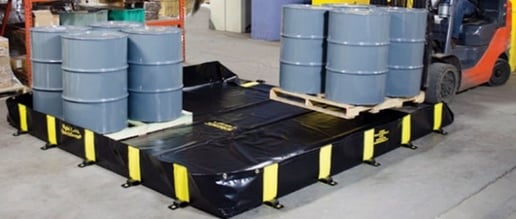
- Portable: Liquid storage materials moveable or not anchored, often called “spill berms”.
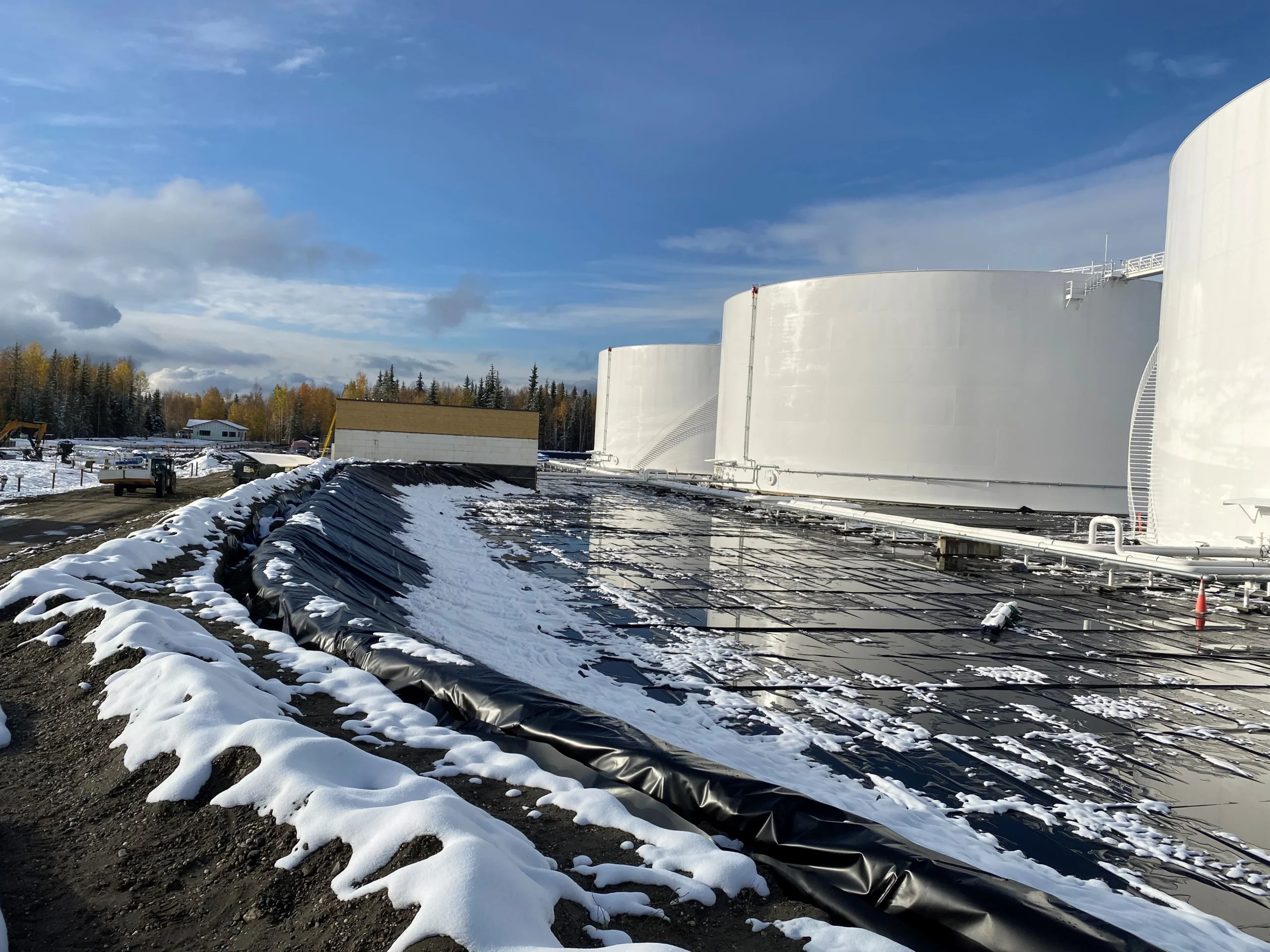
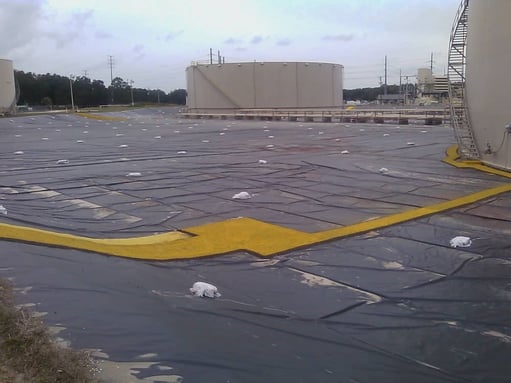 Permanent Secondary Containment, XR-5
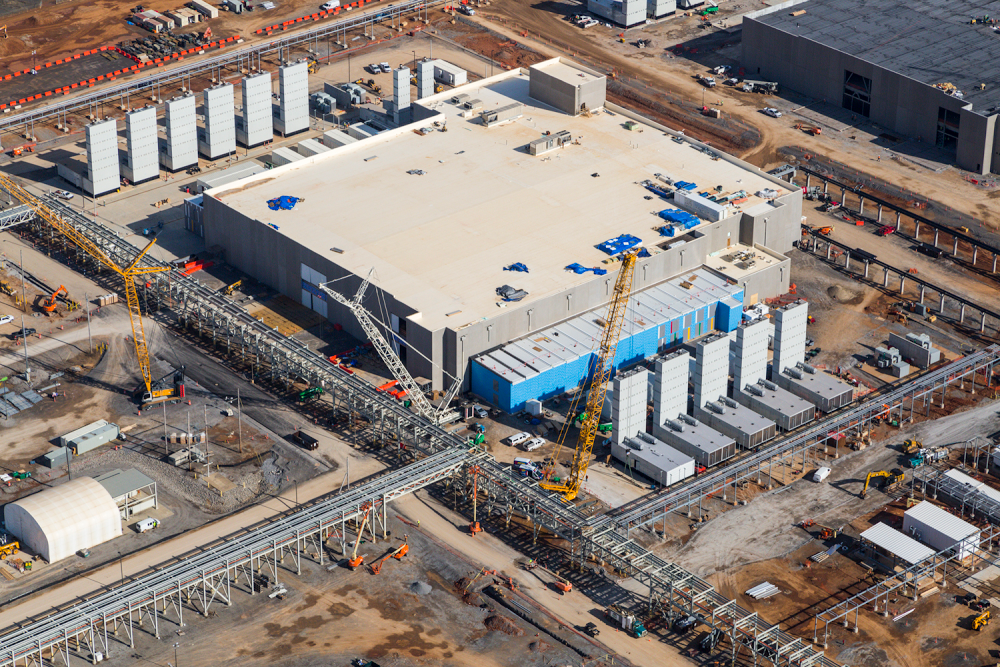
Process Energy, Intersession, FL
Source: Seaman Corp.
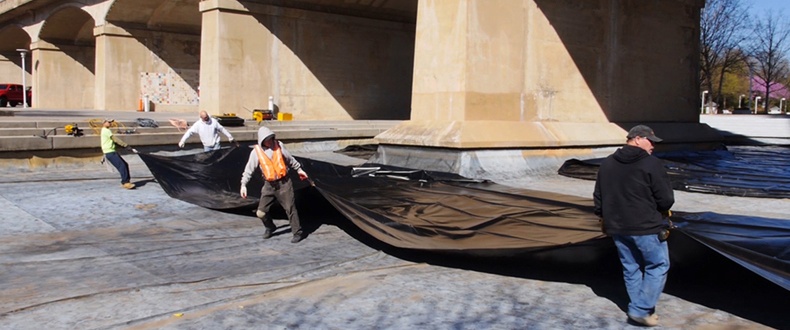
Spill Berms, XR-5 Geomembrane
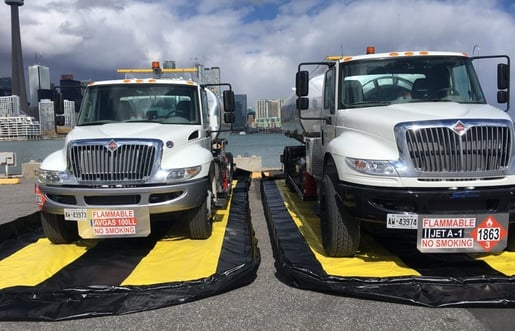
Source: Huskey Portable Containment
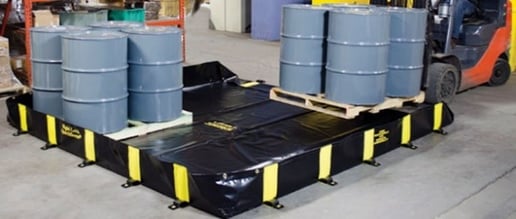
Source: Basic Concepts
Similarities:
- The geomembrane must be resistant to the stored liquid(s).
- Chemical compatibility between stored liquids that might be in contact with each other must be assured.
- The geomembrane must be UV resistant and have low thermal expansion-contraction properties.
- Both require a geomembrane with high resistance to punctures and lateral loading. They both might have some amount of vehicle loading and require design to accommodate.
- Both must be flexible for prefabrication, transport and installation.
Differences:
- Connections are more important with permanent secondary containment. These represent fixed points, and stresses can be concentrated in those areas. Spill containment berms are not expected to be tightly fixed.
- While both can be subjected to vehicle loading, spill berms usually have more frequent traffic, while permanent might have larger, less seldom traffic. More routine live loads can be expected with spill berms. This also implies there would be more ongoing micro loading. Required for permanent secondary containment installations are firm subgrades capable of handling loads as dictated by the application for the long term.
- Spill berm sidewalls may be designed for flexing for drive-on or drive-through
- Spill berms are sometimes manufactured and purchased in bulk and then stored after purchase for spill use, which introduces shelf-life concerns.
- Spill berms seldom require field seams. Permanent secondary containment geomembranes are typically larger and may require some field seaming and connections. Using a flexible reinforced geomembrane allows for prefabrication and greatly reduces field seaming requirements.
Understanding these common features and the differentiating features, consider these factors when selecting a geomembrane for secondary containment:
- Chemical Resistance – Long-term resistance to the stored liquid is essential. It is unlikely 100% of a spill will be completely recovered and the membrane must be able to withstand residual amounts and/or small leaks that remain in contact.
- Mechanical Resistance – Punctures, abrasion (installation or repeated dragging), and induced tension from wheel loads will occur. A heavily reinforced geomembrane like the Ethylene Copolymer XR-5 gives the highest level of performance assurance.
- UV, Thermal Stability – Sunlight resistance is a given. Negligible thermal expansion-contraction is essential and especially when considering stresses on fixed anchor points.
- Vehicle traffic – Understand the way the system will operate and what loads the geomembrane will incur, defined as possible. Providing a tracked surface, such as the XR Walkmat over the liner can make access easier (see flat yellow material in photos above).
- Deployment – The geomembrane must be able to withstand the rigors of installation either in field panels or in a total finished spill berm unit.
Consider the requirements of the application including long-term chemical resistance and survivability of the geomembrane. Select and design a proven material with a demonstrated history of success in similar installations.