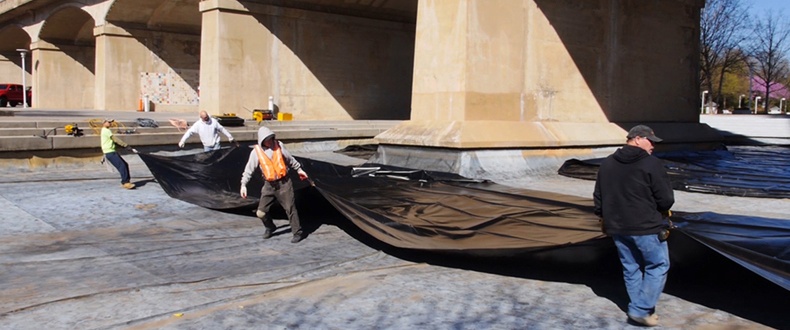




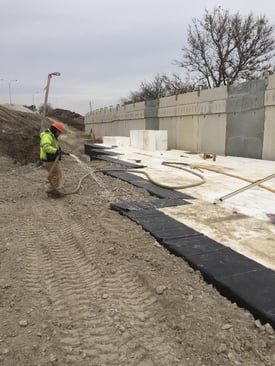
 XR-5 Geomembrane during installation
over EPS Geofoam on Ohio’s Interstate 75.
Seaman Corporation Photo
“Impermeable” is a common, assumed descriptor of a 21st century geomembrane. We use impermeable barrier materials because they are relied upon to prevent the passing of liquids when used in a variety of engineered projects where a barrier is necessary. Geomembranes are specified for these projects because they are lightweight, easy to install, cost-effective and reliable. To ensure you are selecting the right geomembrane for the application, it’s important to look at testing results for vapor/solvent transmission and puncture resistance, as well as real-world performance.
Measuring Permeability
Permeability for geomembranes is actually measured in the laboratory as vapor (water) or solvent transmission rather than a flow of water, which is the measurement used for materials such as clay. The most common test method is ASTM International’s Active Standard D814 (ASTM D814). Some plastics have very low measurable vapor transmission, but those values are theoretical laboratory measurements. Whether the value is measured at 10-9 or 10-12 cm/sec, it is essentially zero. As a reference, compacted clay is on the order of 10-6.
But to achieve such a low vapor transmission rate, the material cannot have holes. It must be constructable. With geomembranes, puncture is a common concern, and puncture resistance is laboratory measured according to ASTM D4833.
This test uses a probe that continuously adds load until a breech occurs. Puncture strength, a good indicator of geomembrane survivability, increases with added weight of the reinforcing fabric and/or polymer thickness. Field workability, on the other hand, decreases with polymer thickness and/or stiffness of the membrane. These are critical considerations, as very low permeability is only effective if the geomembrane can be constructed properly and operated in a secure manner to prevent punctures.
Performance in the Field
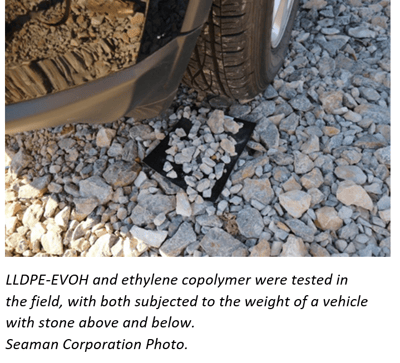
Consider a normal construction site where a geomembrane is to be installed. The geomembrane will be subjected to dragging and other rough handling. A field comparison was conducted between very low- permeability linear low-density polyethylene (LLDPE) membrane packaging films with an ethylene vinyl alcohol (EVOH) layer, and a fabric-reinforced ethylene copolymer membrane with low permeability, both of approximately the same thickness. Ethylene copolymer is routinely used to protect expanded polystyrene (EPS) foam in lightweight fill applications, primarily in transportation, while the LLDPE film is promoted as an engineered equivalent. In the field test, both materials were subjected to the weight of a vehicle, with stone above and below, to assess the puncture damage:
- Comparing the damage to the two materials showed the reinforced ethylene copolymer had no punctures while the LLDPE-EVOH had extensive damage. The low laboratory vapor transmission does not mean much if the membrane is easily damaged during installation activities in the field.
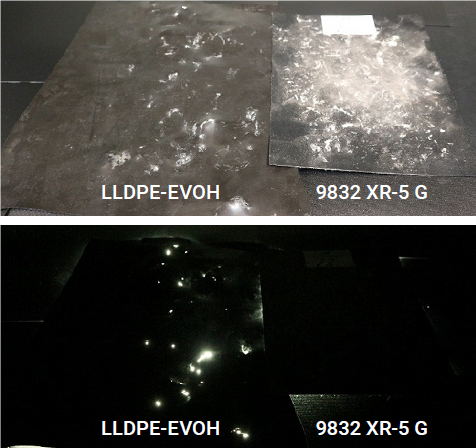
Geomembrane field puncture test samples on light table.
Top photo: Room light on Bottom Photo: Room light off
Seaman Corporation PhotosThe key takeaway? The survivability of a geomembrane must be assured for any other properties of geomembranes to matter.
Geomembranes are proven engineered products that give the designer and owner cost- effective, reliable containment assurance. However, they must, like all elements of a construction project, be capable of being deployed and permanently installed. That means they must survive the rigors of installation and long-term use. When considering barrier options, look closely at all the geomembrane’s properties and discuss survivability with the manufacturer. Be assured of what you are getting.
For more valuable information, download the full white paper comparing the laboratory and field testing of these products.
DOWNLOAD NOW