




Navigating Unexpected Contaminants with Your Geomembrane System
Part 2: Essential Evaluations for When Your Geomembrane System Encounters Unexpected Containments
The first part of this series identified ways a geomembrane lining system may encounter unexpected contaminants. This second part will focus on methods to handle changes in chemical makeup of contained liquids and ways to build safety factors by the selection of the geomembrane itself.
Chemical compatibility testing is the best way to establish a performance baseline from a chemical resistance standpoint. Good industry practice calls for field or laboratory (preferably field for mixed solutions) total immersion testing to simulate actual installation conditions. If the test samples are protected in any manner, such as covering exposed edges to isolate the fabric reinforcing, or altering the liquid temperature, the test results will not be correct. Some believe immersions should only have the contained liquid on one side of the geomembrane. In fact, some testing protocols call for one-sided immersion. A full immersion is more aggressive and successful results build safety factor. Testing for compatibility with pure solutions is fairly straight forward. Solutions, or waste streams, can be variable during testing, particularly for mixed solutions insitu, which again measures performance in good realistic test conditions that are indicative of the containment requirements of the geomembrane. Little to no changes in material physical properties during immersion indicate stability. When mechanical property retention vs. immersion time is plotted, the manner of the plot is most important and is a good indicator of performance, under that set of conditions. With proper interpretation, it also gives implications of performance under other conditions. Negligible change in solvent vapor transmission after immersion indicates stability.
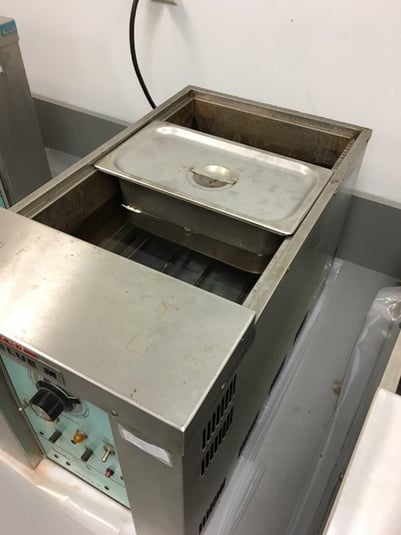 Laboratory Immersion bath
What do you do if a new contaminant is introduced in volume, concentration and/or frequency that is known or suspected to be incompatible with the current geomembrane lining system? For that matter, what is the temperature of the contained liquid, and does it increase greatly either as a batch or continuous? Temperature represents another type of unexpected contamination, even though it is a physical change rather than chemical. Is it possible to mitigate geomembrane-liquid incompatibility by altering the liquid in some manner? Surprisingly, there are engineered controls which can be possibly used to make the system work. These included:
- Upstream containment (enhanced source controls)
- Waste stream or product partial isolation
- Influent structure retrofits
- Flash treatment
- Enhanced mixing – to dissipate or dilute
- Others
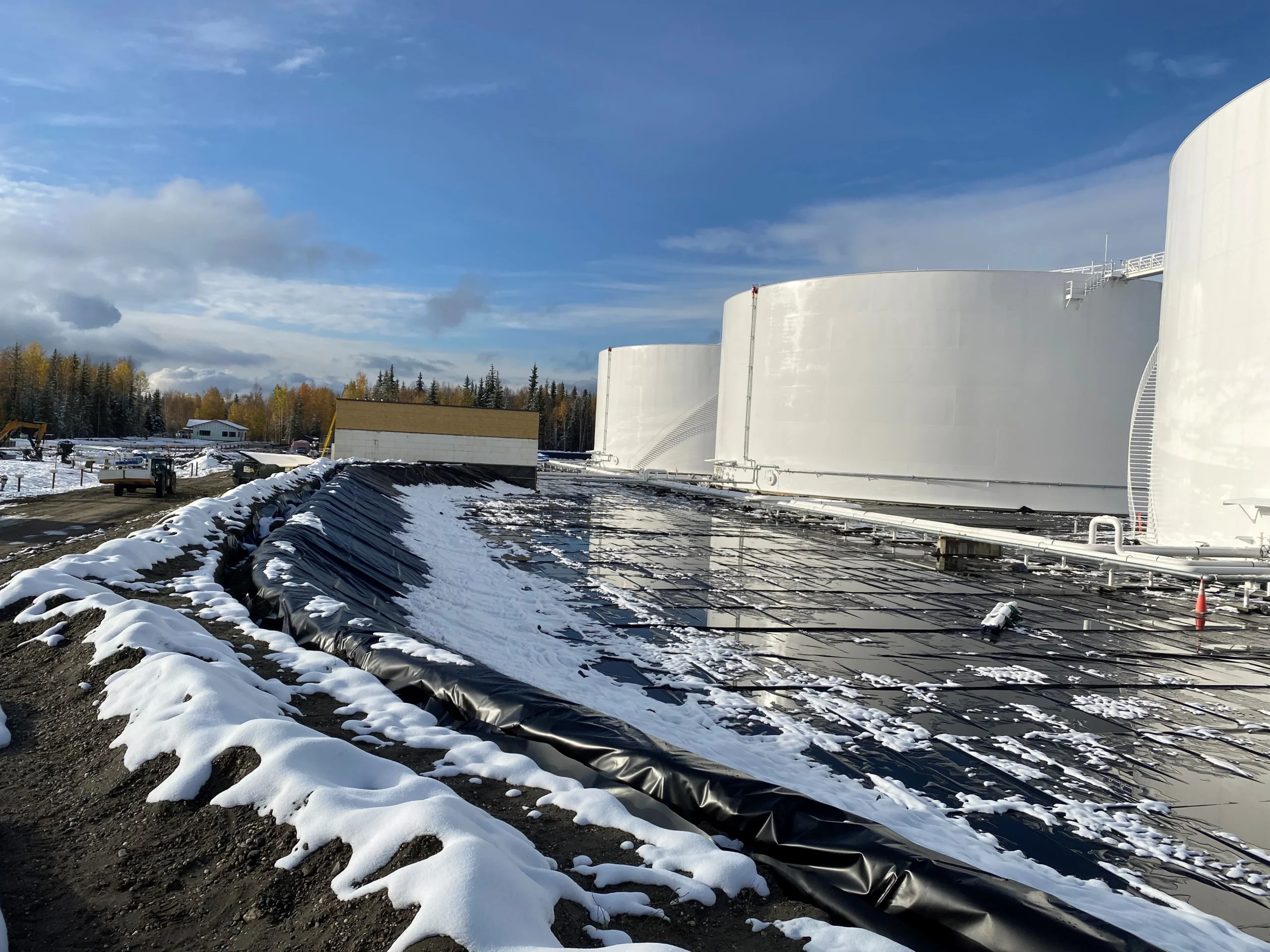
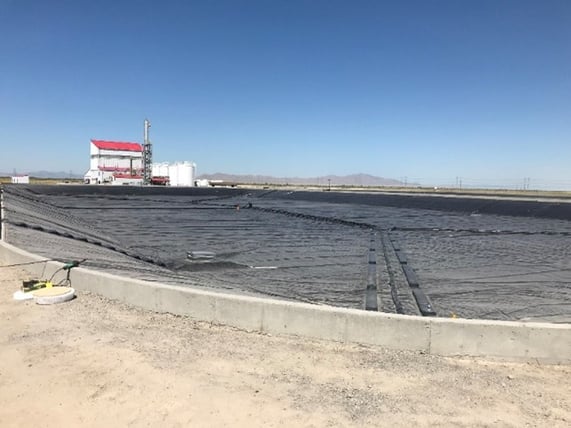 XR-5 Geomembrane Lined and Covered Deicing Fluid Impoundment
Salt Lake City Airport, Utah USA
Photo courtesy of Lange Containment LLC
All these options are process, site, and application specific. Some are merely dilution where conditions allow lowering concentration by mixing with other liquids. While not always possible, lower concentrations may allow continued use of the geomembrane. What is assumed to be constant is the inability of the in-service geomembrane to be altered in any way to change its chemical resistance.
Options to consider:
- Engineered Controls. As discussed earlier, engineered controls are probably the most practical method for preventing failure of the geomembrane if there are new compatibility concerns.
- Rely on industry standards for safety factors. Unfortunately, there are no industry accepted safety factors for chemical resistance. Arbitrarily establishing a safety factor may not be practical, but the options following help formulate a more reliable insight into how the selection of the geomembrane can give added performance assurance.
- Perform accelerated testing at higher contaminant levels. That does not account for future, unknown contaminants but only addresses existing contaminants. Some will suggest testing at elevated temperatures and/or accelerated UV testing, but ASTM, for instance, advises against using that data (ASTM G151-2019 Standard Practice for Exposing Nonmetallic Materials in Accelerated Testing Devices that use Light Sources) for making long term predictions.
- Design for worst case. This is the usual way a potential problem is handled if the worst case scenario is defined or even anticipated when selecting a geomembrane.
- Initially select a geomembrane with broad use and chemical resistance, in the industry of the contained application.
Perhaps the most important way to build safety factor into the facility is to select and design a geomembrane system with proven success in the form of chemical/environmental resistance and survivability. That includes extensive testing data performed by the manufacturer, not by 3rd parties unfamiliar with the material or on some individual component. With proper data and experience, with the specific formulated product, good, reliable information can support performance assessments in light of changing requirements.
Part 3 of this series will give examples of geomembranes presented with unexpected contaminants and the results.