



Wastewater Series: How Geomembranes help to improve Water quality, lower costs and increase efficiencies in wastewater treatment
Part 4 – Geomembrane Applications in Secondary – Tertiary Wastewater Treatment and Residuals Management
“While the environment is a very emotional and even moral issue for most of us, to be effective in the area, as one practitioner put it, you need a good Engineer, not a poet.” – James W. Conrad, Counsel, American Chemistry Council
In the final segment of our look at Geomembrane uses in the wastewater industry, Secondary/Tertiary treatment and Residuals management will be explored.
Secondary Treatment. Secondary treatment is the most common minimum level of treatment for Publicly Owned Treatment Plants (POTW). There are various processes that use geomembranes to make the process more efficient and economical.
Process Baffles – Many treatment processes are dependent on reaction time and thus are negatively affected by short circuiting. Geomembrane floating or fixed diversion baffles are a popular alternative to fixed concrete walls in activated sludge aeration tanks and in-ground impoundments. Reinforced, high seam strength materials are required.
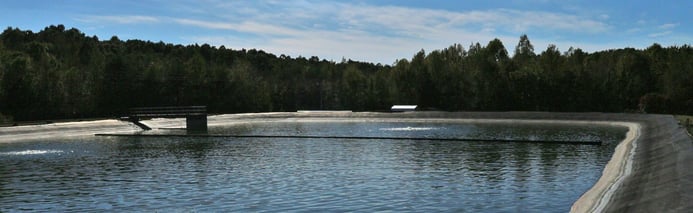 Process Wastewater XR-5 Geomembrane Baffles
Disinfection Chamber Baffles – Similar to process baffles, floating or fixed diversion baffles provide an economical method of controlling contact time during disinfection processes.
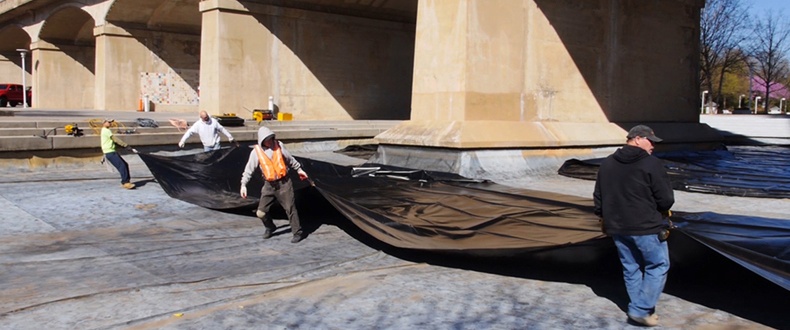
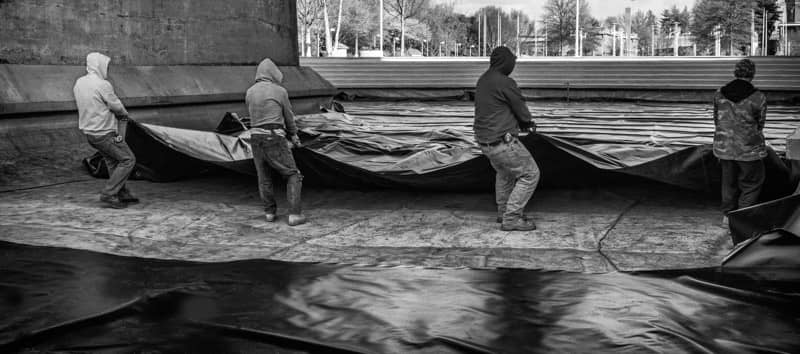
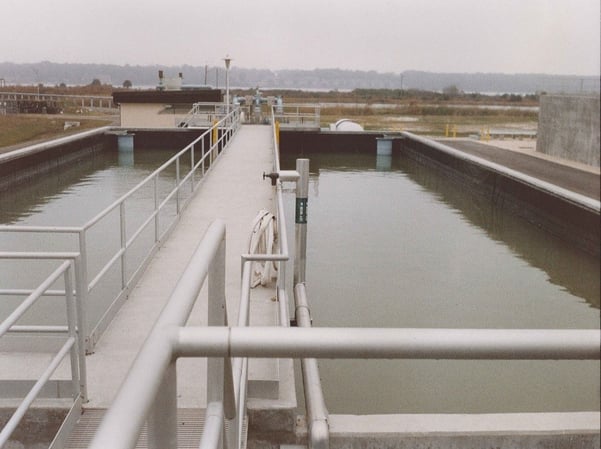 Process Tank lined with XR-5 Geomembrane. Florida, USA
Tertiary Treatment. Geomembranes find use in containment of collected contaminants that have been removed from the waste stream. Two examples are filtered wastewater backwash and concentrates from Reverse Osmosis (RO) processes.
Filtered Backwash – Mixed media filtration is used to remove additional solids from wastewater and is used to further remove chemically precipitated solids. When head loss in a filter becomes excessive, a backwash process removes the accumulated solids, resulting in a concentrated liquid which must be treated. This typically involves a storage step either in a geomembrane lined earthen basin or a tank. The geomembrane must have broad chemical resistant properties and, if an impoundment, it must have high strength, be UV resistant, and must have low thermal expansion contraction properties.
Reverse Osmosis – RO systems produce a reject water that has extremely high dissolved solids and is usually corrosive. The permeate (clear water) produced by the RO process is also very corrosive due to the low Langelier Saturation Index (LSI), a measure of the ultra-purity of the water. Geomembrane lined storage of both liquids requires a high level of corrosion resistance and should always be tested prior to actual application. The XR-5 is the only geomembrane that has been tested with successful results to waters with LSI values as low as -9.
Water Reuse – With Tertiary treatment quality, the reuse of wastewater is possible and is widely used in many areas. The final reuse applications are often seasonal (watering green spaces, etc.) and require long term storage of the water. Geomembranes that require no protective cover are the materials of choice in this application for many reasons. More on these applications can be found in the case history of San Diego water reuse storage impoundment:
XR-5 Geomembrane Lined Water Reuse Storage Impoundments
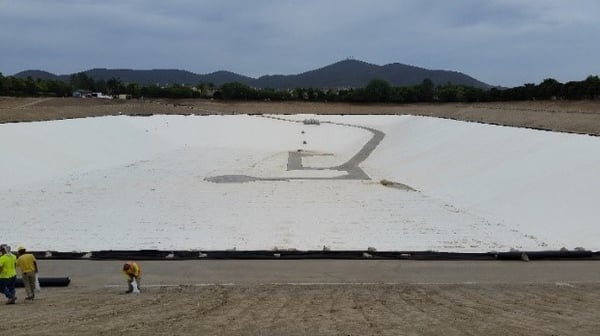 Olivenhain WRRF, San Diego, CA USA
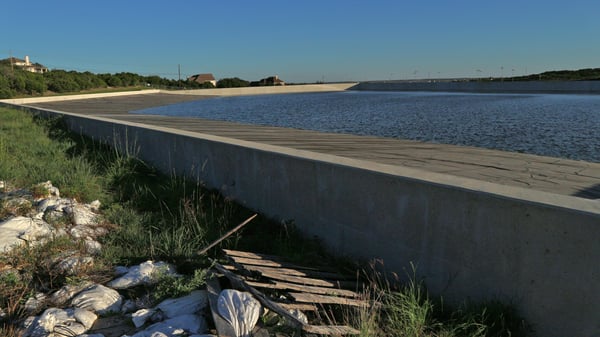 Barton Creek Storage, Austin, TX USA
Residuals Management. As discussed in Part 3, sludges generated by biological wastewater treatment processes are biologically active and usually require additional treatment prior to dewatering. Additional digestion, either aerobic or anaerobic, are common methods of sludge stabilization. The aerobic process is additional aerobic treatment. The anaerobic process may combine primary and secondary sludges and the process vessel (s) is sealed in the case of anaerobic digestion to contain H2S and Methane which are products of the anaerobic process. Geomembrane floating and fixed covers work well as barrier covers for anaerobic digestion, requiring membranes with high strength, flexibility, low thermal expansion-contraction properties, along with resistance and low vapor transmission rates to the H2S and Methane.
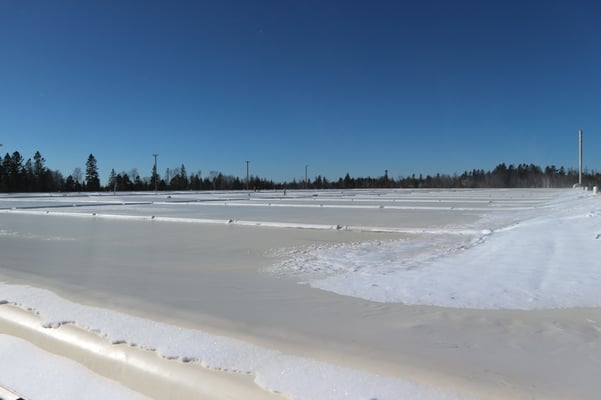 XR-5 Geomembrane Liner and Floating Cover
Anaerobic Digestor
New Brunswick, Canada
In addition to these process specific geomembrane applications in this and the previous post, lining site-wide runoff impoundments and lining polishing ponds are common uses of geomembranes, utilizing the characteristics discussed previously for exposed impoundment liners. Secondary containment of bulk chemical storage utilizing geomembranes is also common.
Wastewater management is important and complex. Most designers have recognized how geomembranes aid in turning wastewater into a water resource, protecting public health and our environment.