



What are the Major Neglected costs in your Geomembrane Installation?
Two Part Blog:
Part 1: 4 Commonly Identified Geomembrane Costs
Part 2: Quantifying Additional Geomembrane Installation Costs
In Part 1 of this series, we reviewed a comparison of two different types of geomembrane systems, strictly from a cost standpoint, ignoring performance differences. In this post, we’ll drill down a bit further into the real cost of installation of these two products, including additional costs required with necessary engineered controls, and additional costs as necessary to make performance more similar. But it also requires a deeper dive into the two materials themselves:
- Non-crystalline, or Amorphous, polymers such as the ethylene copolymer XR-5® have negligible thermal expansion-contraction rates (CTE) and are not subject to environmental stress cracking.
- Crystalline polymers such as polyethylene’s at higher densities have high rates of thermal expansion-contraction, which is cyclic.
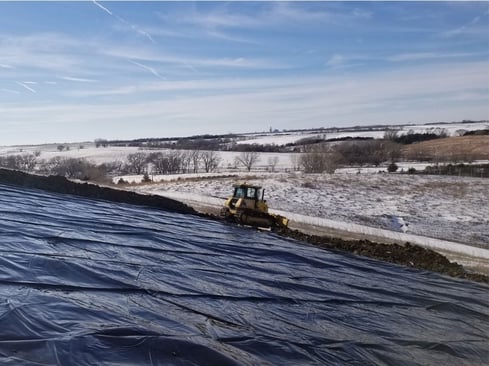
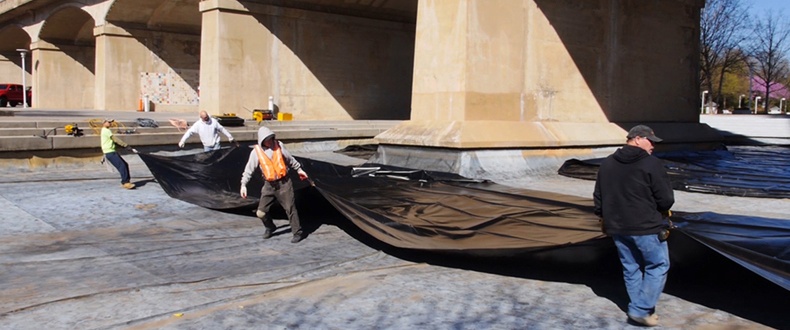
Cover being installed over geomembrane.
Source: www.engineering.unl.edu
Much has been researched and written about the thermal expansion and contraction of crystalline polymers. In the case of geomembranes, industry standards are to cover products such as high-density polyethylene (HDPE) with a granular or earthen overburden in all applications. While some say cover is standard, most point to reasons unrelated to thermal expansion-contraction, but rather to additional mechanical protection for the geomembrane.
Recently however, thermally induced wrinkles have become a major concern and protective cover has been assumed to always be a component of high CTE products. Lighter colors might lower the top temperature, but they do not change the material CTE.
So, the initial cost of granular cover must be considered when it is necessary and not included when unnecessary. In this second part of this series, the cost impact of adding protective overburden to a specific geomembrane installation will be explored.
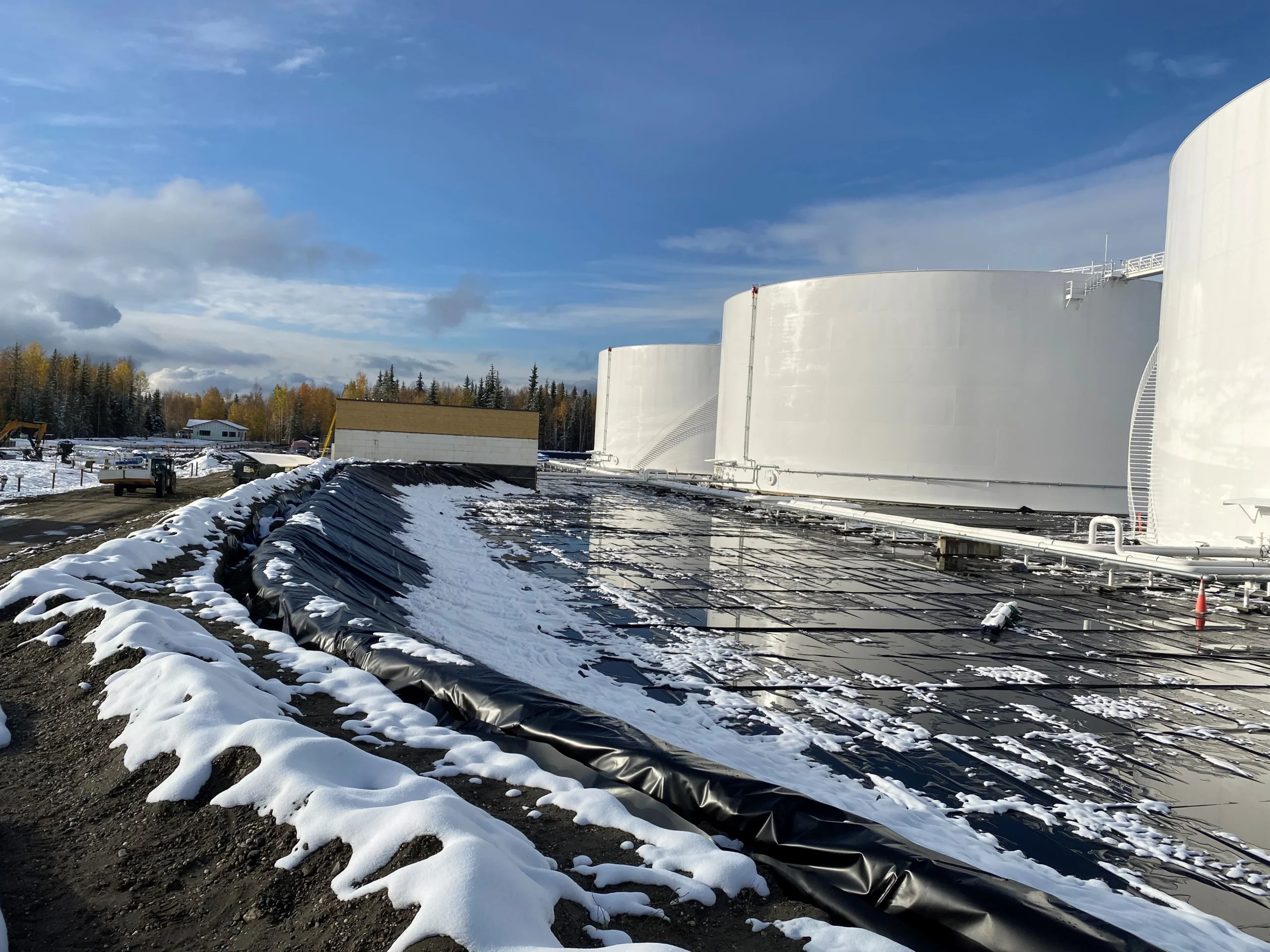
An update of the cost analysis provided in the first of this series was performed in the context of a typical geomembrane-lined secondary containment system, like that shown in the below photograph. The contained liquid is fuel oil; XR-5® is long-term compatible with low permeability, HDPE is assumed to be compatible with unknown permeability.
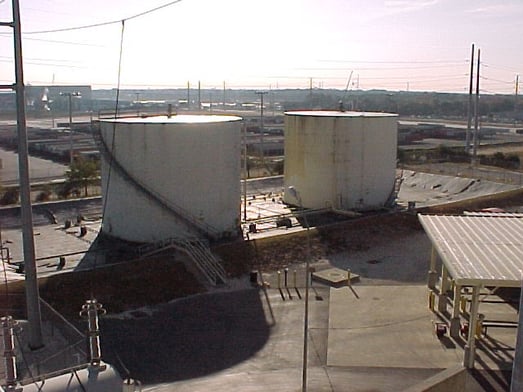 XR-5® Geomembrane Lined Fuel Oil Storage, Florida, USA.
Source: Seaman Corporation
The liner area for the XR-5® is approximately 70,000 ft2 (6,500 m2) and it is approximately 80,000 ft2 (7,400 m2) for the HDPE due to the need for flatter slopes to accommodate the granular cover. For this cost comparison, only one layer of geotextile is included to push benefit of the doubt toward the HDPE. However, for the lower puncture strength product to reach the puncture strength of the XR-5®, a geotextile would be required. (See the original 2019 post for more explanation of this requirement).
For illustrative purposes, the cost data is shown as a bar chart for the two products, 30-mil (0.75 mm) reinforced 8130 XR-5® ethylene copolymer and 80-mil (2.0 mm) HDPE film. The individual cost component’s total allows the reviewer to clearly see the impact of the more complicated field installation and construction quality assurance (CQA), along with the protective cover costs for the HDPE vs. the XR-5®, which has fewer field seams and does not require a protective overburden.
These are hidden costs associated with the selection of a crystalline geomembrane with a high rate of thermal expansion-contraction. The real initial cost of the lower priced polymer product is more than, or certainly comparable with, the reinforced ethylene copolymer XR-5® when the real total cost is compared. Note these costs are for comparative purposes and are approximate based on market conditions in August 2021.
Don’t be fooled by only partial initial costs of your geomembrane installation—Look also at the additional engineered features necessary to make it work.
For more details on this cost comparison, contact Seaman Corporation at 330-262-1111 or info@xrtechnology.com.
For a complete comparison of the XR-5® Ethylene Copolymer geomembrane with Crystalline geomembranes, view our XR Geomembranes vs. HDPE Geomembranes Comparison.