



Application Snapshot:
Installation: Barton Creek
Location: Austin, TX
Purpose: Reuse Water Storage Impoundment
Owner: Travis County Municipal Utility District (MUD)
Solution: XR-5® 8138 40 mil
Engineer: Murfree Engineering
Fabricator & Installer: Lange Containment
Date Installed: 2017
Government agencies, utilities, and industrial customers are increasingly relying on geomembrane solutions for projects that could potentially threaten the environment. Cost-effective due to their ease of installation and proven to be reliable for decades, geomembranes have become a popular front line in protecting natural settings.
Water reclamation is a vital part of the services provided by government and water agencies. The public demands it be done correctly.
A Difficult Task
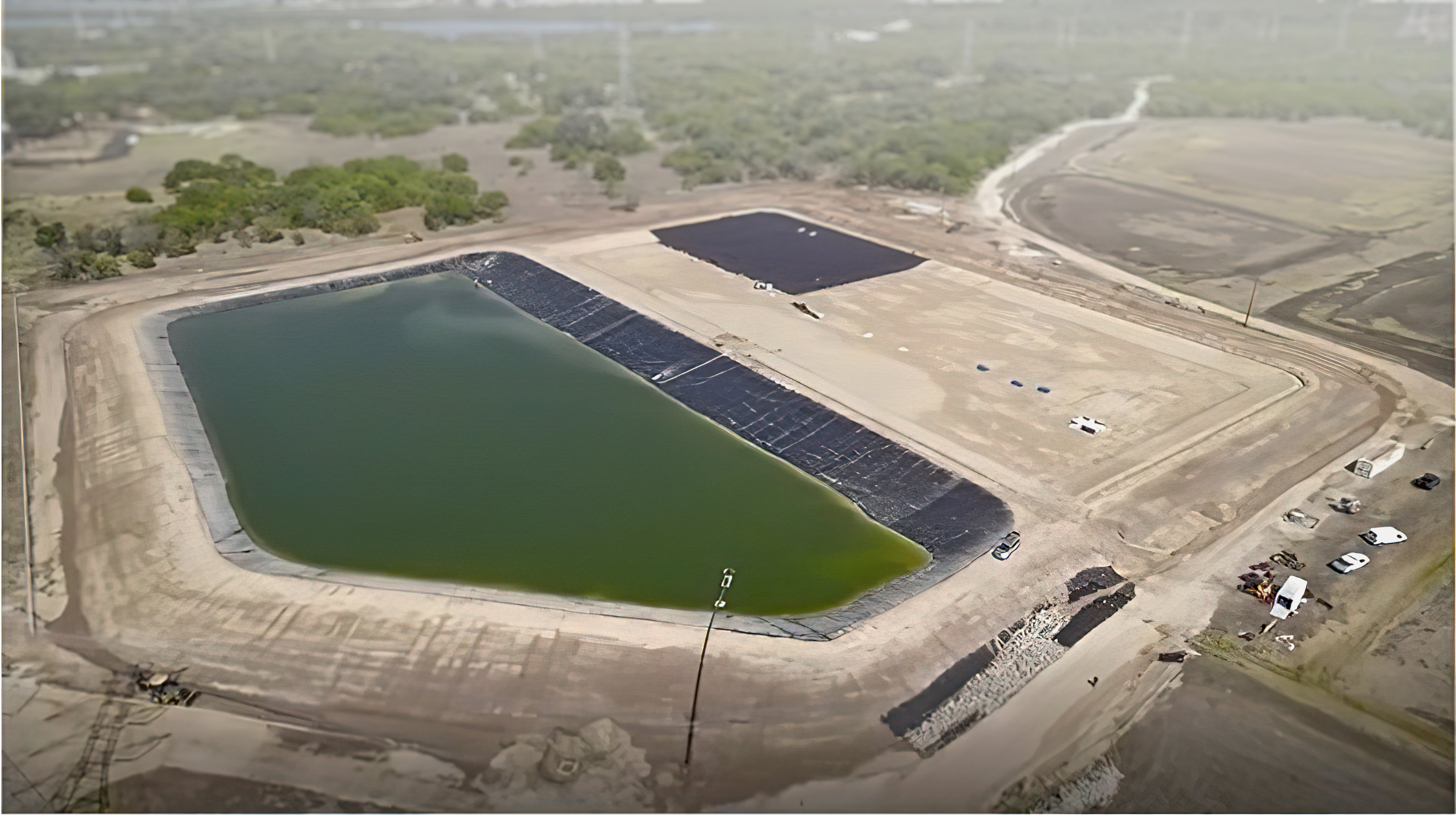
The City of Austin, Texas needed to line a 101-acre-foot (125,000 m3) effluent storage pond containing reclaimed water and needed robust geomembranes with long-term service life. The project had several factors that made it particularly difficult.
- The pond was in a large commercial development within the Lake Austin and Barton Creek watersheds, and within the Edwards Aquifer contributing zone. It also sat near a 4,000-acre nature preserve with several known endangered species in the vicinity. As such, protecting the watershed and environment were of utmost concern throughout the planning, design, and construction phases.
- The aquifer was the source of Austin’s drinking water. The project could not disturb the subgrade beyond four feet (1.2 meters).
- The pond had to be able to store treated effluent and be in compliance with the Texas Commission on Environmental Quality (TCEQ) standards. Storage requirements are generally 50-70 days of storage.
- The state of Texas did not allow for direct discharge of effluent along the watershed. All wastewater had to be used for irrigation.
- The site was sloped, and excavation depth was regulatory restricted.
The reclaimed water stored in the Barton Creek impoundment was treated to tertiary levels and was to ultimately be used as a discounted or free, readily available water source for landscaping and golf course irrigation throughout the Barton Creek community.
The owner, Travis County Municipal Utility District (MUD) no. 4 (Austin, TX) and Consulting Engineers, Murfree Engineering Company considered several geomembranes for lining the impoundment, comparing performance specifications and performance history. They ultimately chose the XR-5® 8138 40 mil (1.0 mm) geomembrane for several reasons:
- High strength, tensile, seam and puncture properties
- No protective cover was required
- Exceptionally low thermal expansion contraction characteristics
- Broad chemical and environmental resistance
- Minimal field seams required
The Construction
A traditional impoundment can have a near flat bottom or can have a sloped depth and is often equipped with a sand or synthetic under-drain system. Because of the four-foot-deep rule to protect the aquifer, this pond had to be designed completely differently. The impoundment was completely above-ground, using approximately 7,200 yd3 (5,500 m3) of concrete to construct walls up to 3.5 feet (106 cm) thick and ranging in height from 4 to 32 vertical feet (1.2 to 9.8 m), to accommodate existing topography. Shown below is a N-S cross section with the original ground surface and the constructed wall which allowed the impoundment to take advantage of the topography while complying with the 4 ft (1.2 m) maximum excavation limitation. Additionally, a 30 in (76 cm) RCP stormwater pipe was placed under the geomembrane, draining stormwater flow from up-gradient of the impoundment.
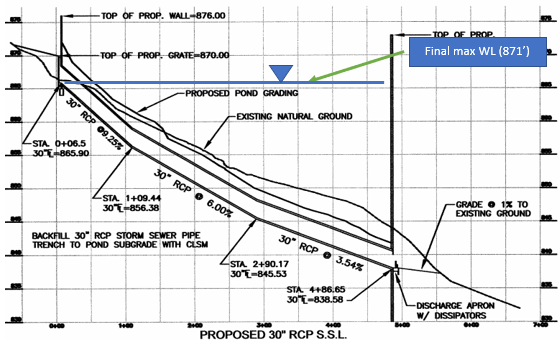
N-S cross section MUD No. 4 Barton Creek Effluent Impoundment
Source: Murfree Engineering
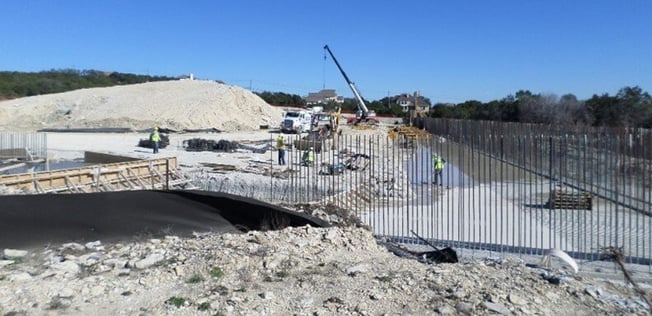
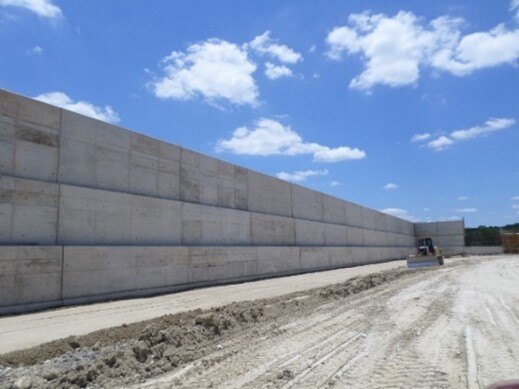
Concrete wall construction
Source: Murfree Engineering
The impoundment used 30,000 yd2 (25,000 m2) of double-sided geocomposite for the under-drain and a matching 30,000 yd2 (25,000 m2) of 40 mil (1.0 mm) reinforced ethylene copolymer (XR-5) coated geomembrane. The geomembrane system could only be attached at the bottom of the pond walls on an engineered concrete “step” poured on top of the pond wall footings. The geocomposite under-drain was attached first and the geomembrane was attached just beyond the extents of the under-drain using stainless steel batten bar supports with gaskets and a watertight sealant. Elevated air vents were custom-made to allow for the 2 ft (60 cm) of freeboard mandated by the State of Texas on all wastewater impoundments. The wall at the upper end of the impoundment was much smaller and the geomembrane was to often be exposed at this end. In fact, the liner was designed to be completely exposed because this pond would be subject to regular filling/emptying cycles.
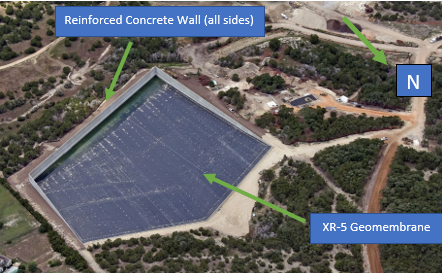
Finished Impoundment
Note: Ground slopes North to South
Source: Murfree Engineering
The Results
The finished facility is an ideal storage and containment structure that meets all requirements and protects the sensitive environment in which it is located. The careful development of the project, including the geocomposite under-drain and geomembrane, added life expectancy and boosted public opinion due to the owner’s commitment to protect the environment.
If you have a challenging need, see how XR Geomembranes can play a key role in the solution. Contact us to learn more about wastewater treatment pond liners.
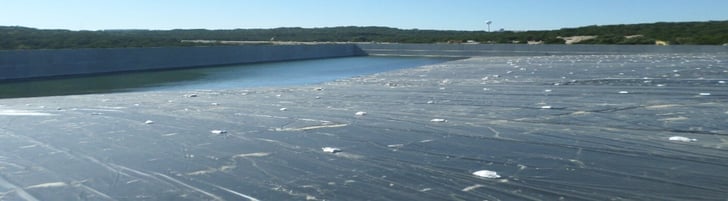
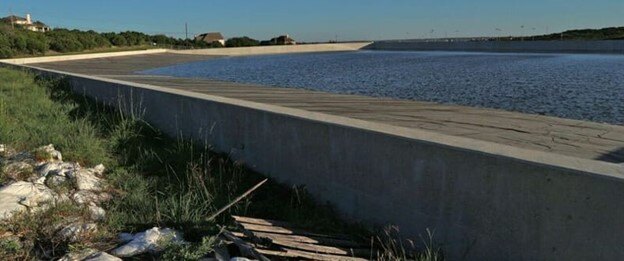 Top image: South wall
Bottom image: North wall
XR-5 Geomembrane Lined MUD no. 4 Barton Creek Effluent Storage Impoundment