




Geomembrane Selection and Use in Evaporation Ponds
Part 2: Evaporation Pond Operation and Geomembrane Performance Criteria
In the second part of this series, we will take a closer look at the processes occurring in evaporation ponds and the anticipated demands on the geomembrane lining system. Click to view Part 1 and Part 3 of the blog series.
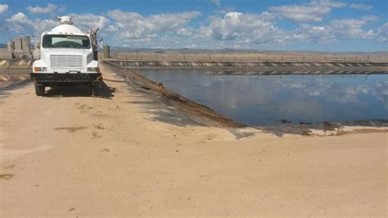 Evaporation pond, Moab, UT USA
Source: Moabnewssun.com
How do Evaporation ponds work?
Evaporation pond processes are often physical processes. It takes the water component from a surface water body, leaving behind the solids contained in the water. NaCl (salt) is a common solid removed via evaporation. When dissolved in water, it has the appearance of a physical equilibrium in that the NaCl has the same composition before going into the solution as it does while leaving the solution. Many sources contend that this is a chemical change that is merely reversed when the concentration of the solvent (water) is reduced, favoring an increase in the concentration of the solute (NaCl). Here, this is a physical process, taking the water component from a surface water body, of leaving behind the solids.
Evaporation with hydrocarbon content is a different process. The difference in polarity between hydrocarbons and water makes them unattractive to each other, and coupled with the difference in specific gravity, the two liquids will retain their composition and exist separately in a containment area. Except for some amount of emulsification, the hydrocarbons will float, limiting the climatological effects causing evaporation. So, pretreatment to remove as much floating oil as possible is necessary to allow exposure of the water surface to the atmosphere. Agitation, in most evaporation ponds, increases the rate of water loss to the atmosphere. The separation and concentration of hydrocarbons means the geomembrane will be in long-term contact with possible damaging liquids.
Evaporation ponds will typically leave solids after the water is evaporated. In some situations, the site is closed with the solids in situ, and others remove the solids periodically for either recovery or disposal. Evaporation processes can be batch, single or multiple, or can have recurring inflow.
Geomembranes are usually a barrier to prevent a liquid from leaking and damaging groundwater. In many process applications, that is also true, but the barrier assumes a second role: Retaining valuable process liquids. In the case of Evaporation ponds, a geomembrane is used as a barrier to also retain solids, maybe valuable, maybe not. In the first post, the production of NaCl by evaporating seawater in lined impoundments was outlined, presenting a real, large-scale, example of geomembranes retaining valuable solids for ultimate recovery.
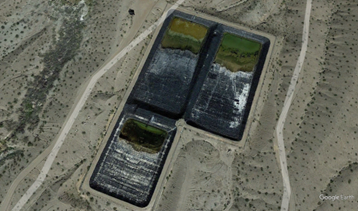 XR-5 Geomembrane Lined Evaporation Ponds. 500,000 sq ft., Oil and Gas Application.
California, USA
Source: Google Earth
What are the geographic and operational characteristics of evaporation ponds and what is their influence on geomembrane operations?
Evaporation ponds typically have some common characteristics.
- They are in open areas to take advantage of the wind in the process.
- They are in warm to hot environments where evaporation exceeds rainfall yearly.
- Ponds are shallow to get maximum heat and UV into the liquid. (High temperature)
- Ponds may require the removal of residual solids or maybe one-time use batch operations with in-situ closure. (Puncture, abrasion)
- Side slopes are exposed to sunlight to get maximum exposure and heat buildup. Many geomembranes are not recommended for exposure due to thermal swings.
- They require low permeability containment for the entire wetted area including the freeboard area to the top of the perimeter slopes.
- Contained liquids can be aggressive against the geomembrane.
- Chemical attack on the geomembrane is more likely with elevated temperatures.
In Post 3 of this series, specific details on the geomembrane performance criteria along with two examples of evaporation pond geomembranes will be provided.