
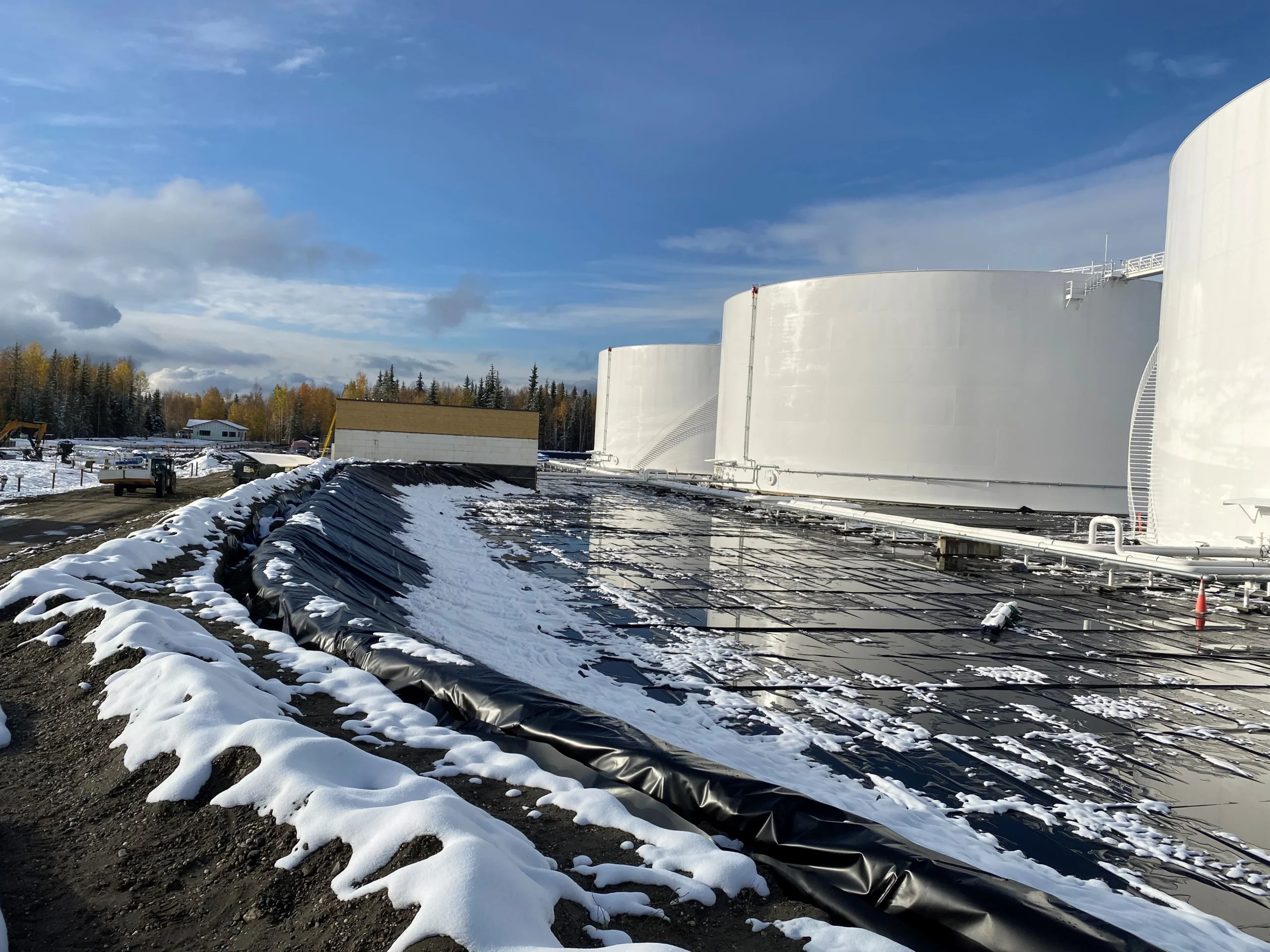



Federal regulations requiring safeguards against spills of bulk liquid storage (most commonly petroleum) have been in effect since the Clean Water Act was passed in 1972. Geomembranes are used to line bermed areas that have been created to provide sufficient storage volume for spill containment and associated rainfall. There are important properties that determine which geomembranes are most suited to these critical applications:
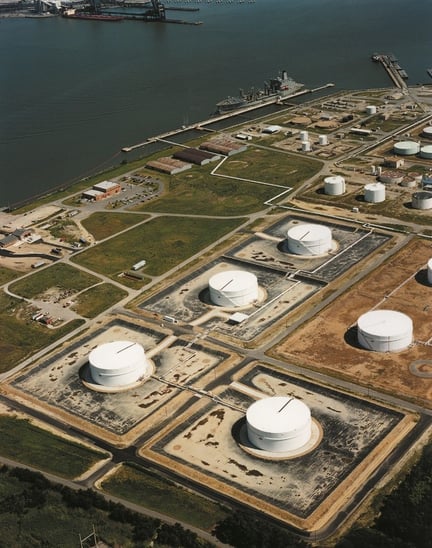 USN Craney Island Fuel Depot, Norfolk, VA; XR-5® Geomembrane.
Source: Seaman Corporation
- Chemical Resistance— Secondary containment systems are designed to contain small leaks or massive spills. Some will say that the geomembrane must only contain the spilled liquid for the length of time necessary to clean up the spill, which can be somewhat ambiguous. However, it is unlikely 100% of the spilled liquid will be recovered, and particularly in the case of a small spill, the geomembrane may be in contact long term with the stored product. It’s important to look for long-term immersion data, low permeability and product compatibility.
- Constructability and Survivability—In a recent blog, we presented some field testing that pointed out that a thin multilayer geomembrane film with extremely low hydrocarbon permeability performed poorly against the rigors of construction activity. Damage resulting from handling and placement, in addition to placement on an imperfect subgrade, demands a tough geomembrane. Further, during service, the barrier material must continue to resist operational/maintenance activity within the containment area. Consider puncture, yield tensile strength, sustained loading seam strength (dead load) and abrasion characteristics of the geomembrane. Avoid products that require a protective cover to control thermal expansion-contraction.
- Thermal Expansion-Contraction— As mentioned above, some geomembranes require special controls to compensate for thermal expansion-contraction. Crystalline polymers have high rates of thermal expansion-contraction, caused by diurnal temperature swings. The result is thermally induced polymeric expansion and contraction that is concentrated at static points, such as pipe penetrations and perimeter attachments and field seams.
It has long been noted that many installation leaks are caused by damage during placement of a protective cover (Peggs 1999 and Kelsey 2017). Noncrystalline geomembranes, such as the XR-5® Ethylene Copolymer, have negligible thermal expansion-contraction rates and do not require a cover to compensate. Geomembranes with low thermal expansion-contraction rates provide for simpler design, installation and long-term maintenance.
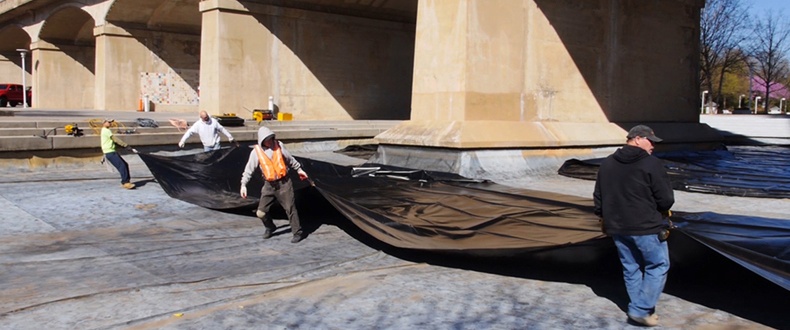
- Geomembrane Prefabrication— Flexible geomembranes can go through a second manufacturing step to create large panels for field installation. Larger panels equal fewer field seams. Minimizing field seams has several advantages:
• Faster, simpler installation.
• Less Construction Quality Assurance (CQA) cost.
• High system reliability due to fewer field manufactured connections.
Flexible geomembranes also make pipe connections and other fixed penetrations/connections easier to seal. Use flexible geomembranes that can reduce field seams by as much as a factor of three. - System Cost— One of the jobs of the design engineer is to accomplish the project goals at the most economical cost. So, you must consider that the cost of a geomembrane secondary containment system includes more than just the membrane; it includes other features and products that must be engineered into the facility to make the geomembrane workable. Based on items 1-4 above, there are cost savings with each feature:
• Chemical resistance and low permeability — Long-term compatibility, no replacement in the event of a minor spill.
• Constructability and reliability — Reduce or eliminate the protective cover and other redundant protective layers.
• Thermal expansion-contraction — Eliminate geotextile protection between the geomembrane and the protective cover. Eliminate the protective cover. Utilize steeper slopes with less geomembrane area and less footprint.
• Geomembrane prefabrication — Reduce the number of field seams and CQA.
For more information on the industry-leading secondary containment geomembrane, XR-5, visit our website.