




April is National Welding Month, a good time to break down the types of coated fabric welding we offer, starting with radio frequency (RF) welding and hot air welding. While at times both can be applied to the same application, that does not mean the methods are the same or that you are choosing the right one for your project. Knowing the difference between the welds lets you make an informed decision on which is best for your next project.
What is RF welding?
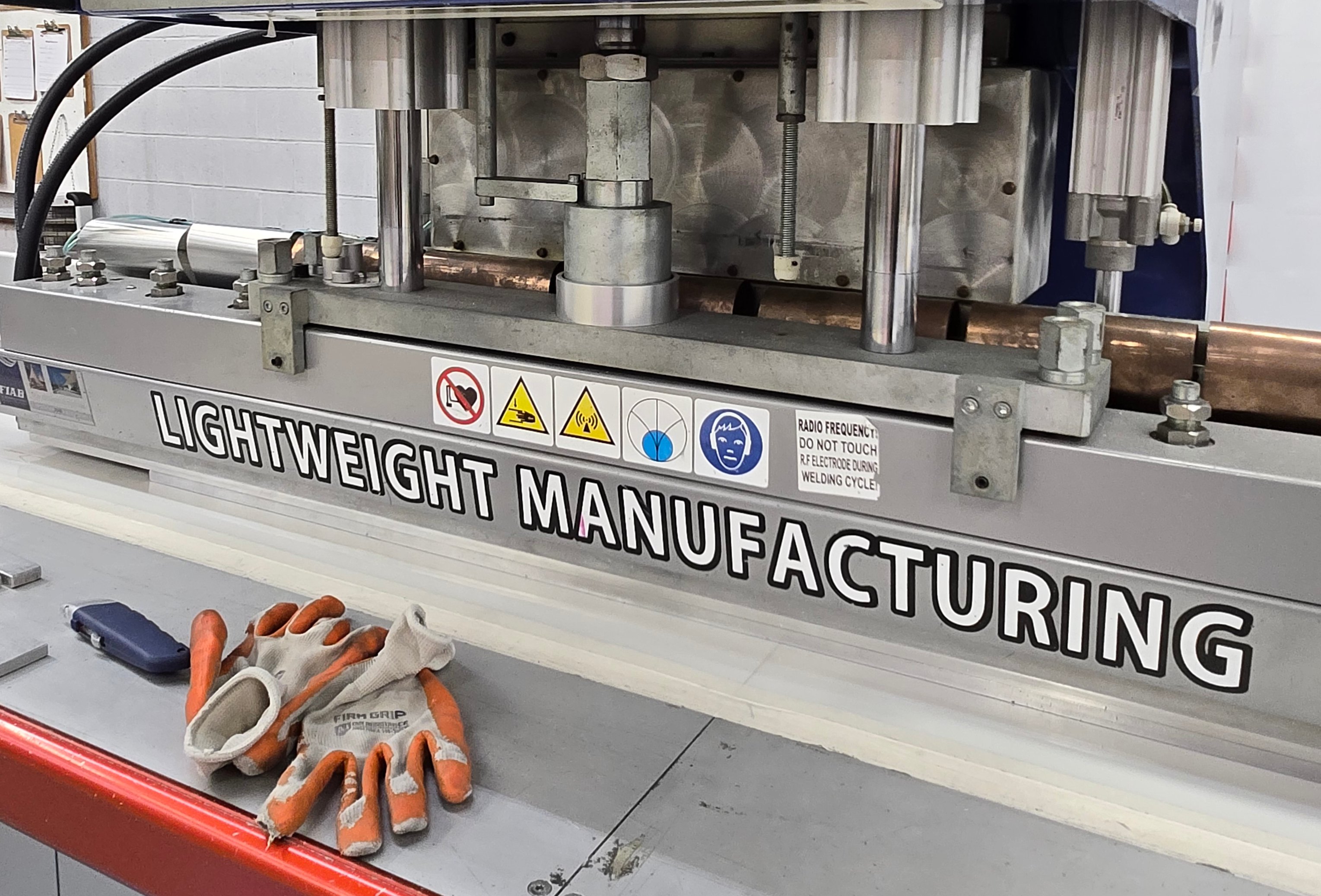
RF welding, or radio frequency welding, is a process used to join materials (in our case, coated fabrics) by heating the material on the inside using high-frequency electromagnetic energy (27.12 MHz) to fuse the two materials together. The process is performed on an RF welding machine. The heat is created by sending radio frequency energy through the layers of plastic material: the dielectric loss (the resistance of the molecules against oscillation) generates the heat inside the material, not through the surface. Pressure is applied at the same time, and after the weld cycle is finished, the pressure is maintained through a cooling cycle.
Advantages
The biggest benefit of RF welding is the consistency of the process. Through test welds, the settings can be fine-tuned. Once the settings for a particular combination of materials and weld size are determined, repeated welds will be consistently high quality.
Another benefit is that multiple layers can be welded at the same time. Because the RF energy is delivered through a metal die that presses on the material, the material is stationary during welding, and complex weld geometries can be accomplished. When RF welding is done with a traveling welder, welding long straight seams becomes very efficient. The two most popular brands of traveling welders are FIAB and Forsstrom.
When should RF welding be used?
For any type of overlap weld with coated fabrics where the coating is a polar polymer, such as PVC or PU.
Projects we have used RF welding on
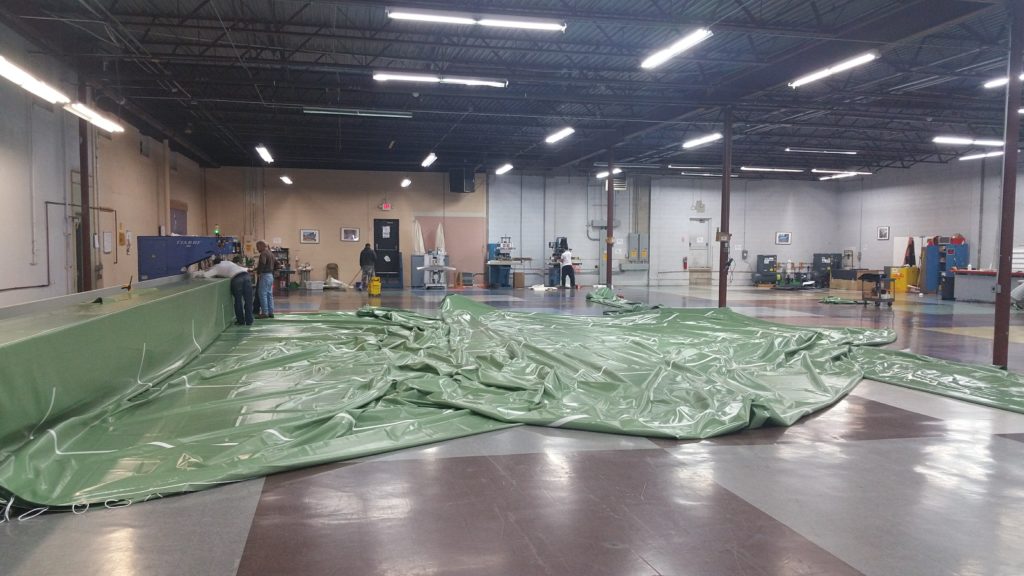
- Fabric panels for frame-supported fabric structures
- Tensile panels
- Rental panels
When should RF welding not be used?
One condition for RF welding to work is that the material is polar. Non-polar polymers, like polyethylene, generally cannot be welded with RF welding.
What is hot air welding?
Hot air welding, or hot gas welding, uses a purpose-designed heat gun that blows hot air between two fabric membranes, softening the coating. Pressure is applied, and when the two fabric membranes cool there is a permanent seam between them. In cases where the fabric is difficult to weld, a welding tape can be applied: a layer of thermoplastic material that melts more easily and joins the two layers of fabric when melted by hot air. Hot air welding is used in different configurations:
- Rotary: the welder is stationary and the materials move through the welder
- Floor welding: the material is stationary and the welder moves along the weld line on the floor
- Track welding: the material is stationary and the welder moves along a track at a predetermined speed
- Handheld
Advantages
Hot air welding is applicable to any thermoplastic material, such as PVC, polyethylene, and polypropylene. Hot air welding can improve the aesthetics of a project because the weld happens on the inside of the materials, which can reduce the visibility of the seam. It also allows for more dynamic creations, thanks to the ability to move the heat gun freely.
When should hot air welding be used?
We recommend hot air welding for finishing work on a building, because it can be done with a handheld hot air gun; for materials where other methods fail; for complex three-dimensional shapes; and for high-speed welding of simple, larger projects.
Projects we have used hot air welding on
- Industrial curtains
- Finishing details
When should hot air welding not be used?
When there are multiple layers to be welded.
What is hot wedge welding?
Hot wedge welding uses a heated wedge that slides between two fabric membranes, softening the coating. Pressure is applied, and when the two fabric membranes cool there is a permanent seam between them.
Advantages
Hot wedge welding is also applicable to materials such as PVC, polyethylene, and polypropylene. Hot wedge welding is more reliable and more precise in where the heat is applied compared to hot air welding, and some welding equipment offers the option to switch between hot air and hot wedge on the same machine.
When should hot wedge welding be used?
We recommend hot wedge welding for long, straight welds where the ability to reproduce consistent weld strengths is important.
Projects we have used hot wedge welding on
- Industrial curtains
When should hot wedge welding not be used?
When there are multiple layers to be welded, and when a weld is required away from the edge of the fabric.
What is hot bar welding?
Hot bar welding uses a heated metal bar that heats the coated fabric from the outside. Pressure is applied, and when the two fabric membranes cool there is a permanent seam between them. The process is relatively slow, since the heat has to be transferred through the thickness of the fabric to the inside between the two layers, using conductive heat transfer.
Advantages
Hot bar welding is applicable to advanced technical fabrics such as PTFE/glass. It can be used for many thermoplastics, but it is generally reserved for cases where other weld methods are unsatisfactory, because of the slow speed of the hot bar. The hot bar is used for many advanced technical textiles, including PTFE-coated fiberglass fabric and other fluoropolymers. With PTFE/glass, an FEP welding tape is inserted between the layers to be welded.
When should hot bar welding be used?
We recommend hot bar welding for any advanced technical textile where other methods do not offer satisfactory results.
When should hot bar welding not be used?
When more efficient methods are available.
Other fabric joining methods
Adhesives
In certain applications, adhesives can be used effectively, especially when the materials are difficult to weld otherwise, and when the process is continuous and repeatable so that settings can be optimized.
Impulse welding
Impulse welding is another form of bar welding in which the temperature is controlled digitally at the surface of the welding bar, for a very precise welding temperature.
Ultrasound welding
Ultrasound welding is used in both rotary and bar welding equipment to weld materials that are difficult to weld otherwise. Ultrasound energy excites the molecules and creates a bond in a diverse range of fabrics.